


How to Measure Bangle Size at Home: 2.2, 2.4, 2.6, 2.8

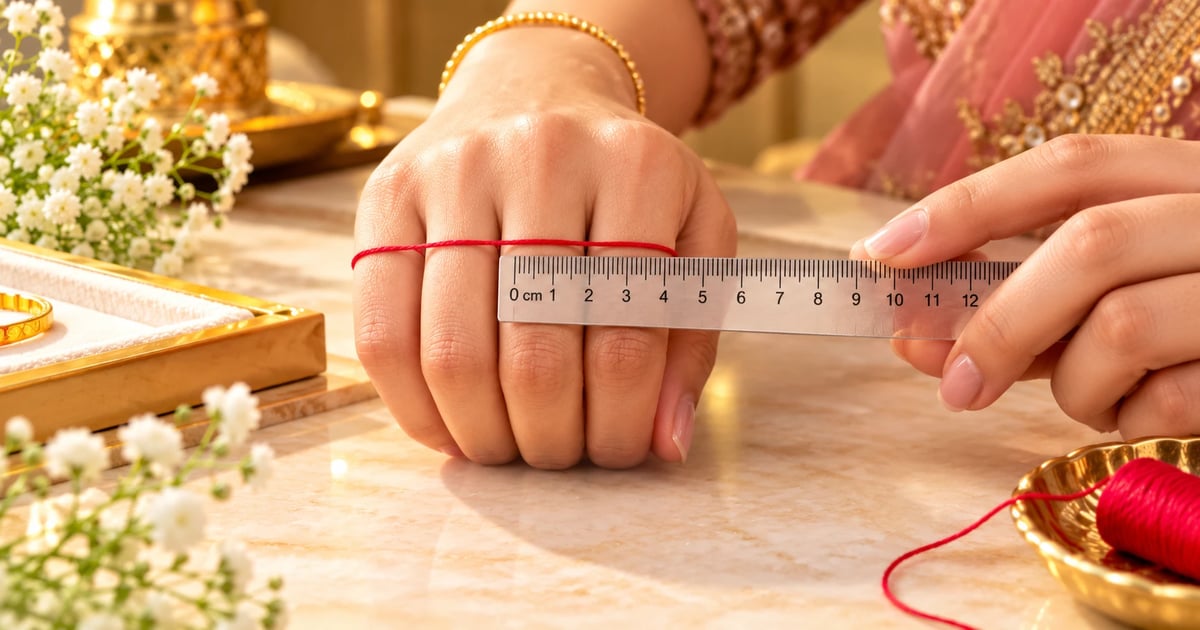
To learn how to measure bangle size at home, measure your folded hand across the knuckles, not your wrist. A rigid bangle has to slide over the widest part of your hand, so that's the number that counts. Then match it to the chart below, which is built from the exact inch.
Bangle Size Chart 2.2 to 2.10 in mm, cm and Inches
Every size here is the bangle's inner diameter, meaning the width across the inside. The circumference column is the inside edge measured all the way round. You can compare a thread reading with it directly.
Size | Inner diameter (inches) | Inner diameter (mm) | Inner diameter (cm) | Inner circumference (mm) |
|---|---|---|---|---|
2.2 | 2⅛ (2.125) | 54.0 | 5.40 | 169.6 |
2.4 | 2¼ (2.250) | 57.2 | 5.72 | 179.5 |
2.6 | 2⅜ (2.375) | 60.3 | 6.03 | 189.5 |
2.8 | 2½ (2.500) | 63.5 | 6.35 | 199.5 |
2.10 | 2⅝ (2.625) | 66.7 | 6.67 | 209.5 |
2.12 | 2¾ (2.750) | 69.9 | 6.99 | 219.4 |
Each step up adds ⅛ inch to the diameter. That's about 3.2 mm across, or close to 10 mm around the inside. The millimetre values use the exact inch of 25.4 mm, as defined in NIST's page on SI units of length.
The 2.12 row is there for kada buyers. Once you have your number, browse our gold bangles and bracelets or gold fitting churi designs.
What 2.4 or 2.6 Actually Means on a Bangle
Read a bangle size as two numbers, not a decimal. The 2 before the dot means 2 inches. The number after it counts sixteenths of an inch.
So 2.4 means 2 inches plus 4/16 inch. That's 2¼ inches, or 57.2 mm across the inside. Size 2.6 is 2⅜ inches, which is 60.3 mm or 6.03 cm.
This also explains the jump from 2.8 to 2.10. After eight sixteenths comes ten sixteenths, so 2.10 is bigger than 2.8. It's 2⅝ inches, or 66.7 mm. It isn't 2.1, and it isn't smaller.
Older jewellers sometimes call these steps annas, borrowing the old rupee that split into 16. You may also see odd sizes such as 2.3 or 2.5 on some shakha and pola. The logic holds: 2.3 is 2 and 3/16 inch (55.6 mm), and 2.5 is 58.7 mm.
Method 1: Measure a Bangle That Already Fits
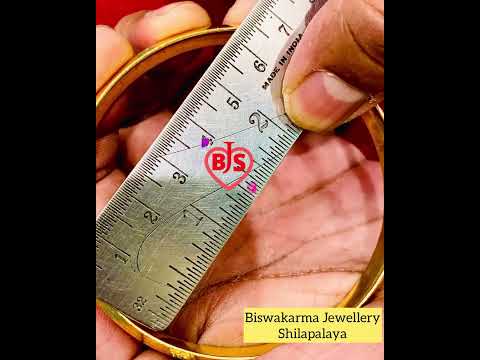
This is the most reliable home method, because it measures a real bangle, not skin. You need one rigid bangle and a millimetre ruler.
Choose a round, rigid bangle that goes on with a gentle squeeze. Skip openable kadas, bracelets and anything you never take off.
Lay it flat on a table. Place the ruler across the inside, from inner edge to inner edge.
Read the widest point in millimetres. Then turn the ruler a quarter turn and measure again.
If the two readings differ by more than 1 mm, the bangle is slightly oval. Add them and halve the total.
Match your number to the inner diameter column above.
A reading of 60 mm in both directions points to 2.6. Don't include the metal's thickness. Only the open space inside matters.
Method 2: How to Measure Bangle Size at Home With Thread
To measure bangle size at home without a bangle, fold your hand as if slipping one on. Wrap a thread around the widest part of the knuckles. Measure the thread in millimetres and divide by 3.14. Then pick the first chart size at or above that number.
Here's how to get a clean reading with thread, a paper strip or a soft measuring tape.
Bring your thumb in towards your little finger, the way you do when putting on a bangle. Keep the hand relaxed.
Wrap the thread around the widest part, across the knuckles and the base of the thumb.
Hold it snug against the skin, not tight. Pinch or mark the point where the ends meet.
Lay the thread straight along a ruler and read it in millimetres.
Measure twice and keep the larger reading. Also measure the hand that will actually wear the bangle.
Cotton thread or a paper strip works best. Wool and elastic stretch, so they give a short reading.
Convert Your Hand Measurement to a Bangle Size
Divide your hand circumference by 3.14 (pi) to get a diameter. After that, choose the first size at or above that number.
Say your thread measures 18.8 cm. That's 188 mm ÷ 3.14 = 59.9 mm. The first size at or above 59.9 mm is 2.6, at 60.3 mm.
You can also skip the division. Compare your thread length straight with the circumference column instead. Here, 188 mm sits just under 189.5 mm, so the answer is still 2.6. That's all a bangle size calculator does.
Never round down. A bangle smaller than your hand reading will be a real struggle to get on.
No Measuring Tape or Ruler at Home?
A thread or a strip of paper does the tape's job. For the reading itself, any school ruler works.
No ruler either? A standard A4 sheet's short side is 210 mm. That's almost exactly the inner circumference of a 2.10 (209.5 mm). If your thread is longer than that edge, you'll need 2.12 or larger.
Between Two Bangle Sizes? A Clear Rule
Start with the first size at or above your hand number. Next, check the gap between that size and your number.
If the size is more than 1 mm wider than your hand number, it should slide on comfortably. When the gap is under 1 mm, expect a snug fit.
Snug is fine for a thin churi you rarely take off. It's a problem for anything wide, heavy or brittle. For example, a hand reading of 57.0 mm gives 2.4 (57.2 mm), with only 0.2 mm to spare.
Our advice: if you're in doubt with a solid gold bangle, go one size up. A slightly loose bangle can still be worn. One that won't cross your knuckles can't, and gold doesn't stretch.
Thin Fitting Churi vs Wide Bala and Kada
Width changes the fit. A thin churi can be tilted and rolled over the knuckles. A wide bala or kada can't tilt much, so it has to clear your hand almost straight.
That's why the same hand might wear a 2.4 churi but need a 2.6 bala. Flat inner walls also feel tighter than a rounded inside edge.
If you're choosing a broad piece, browse our gold bala collection with the wide-bangle rule in mind. Our gold bala designs and price guide covers widths and weights.
Should a kada be one size bigger than your bangle size? For a solid, wide kada, usually yes. An openable kada with a screw or hinge is different, since it opens around the wrist. Men's kadas use the same numbers, just further up the chart. You'll find them under gold Punjabi kada.
Sizing Shakha, Pola and Noa Bangles
Shakha is the white conch-shell bangle. Pola is the red bangle worn beside it, and noa is the iron bangle, often cased in gold.
Shakha can't flex at all, and forcing it can crack it. So never size shakha snug. Use the gap rule above and choose the roomier size when you're close.
Because shakha is cut from a natural shell, the inside is rarely a perfect circle. Measure it in two directions and average them, as you would with an oval bangle. Most pola is also wider than a fitting churi, so apply the wide-bangle rule.
With gold-bound shakha or pola, the inside measurement still decides the size. Ask whether the gold casing wraps inside the ring too, because that takes up room.
Noa follows the same logic. Treat a thin noa like a fitting churi and a broad one like a bala.
Shakha and pola are usually worn as a pair. Order them in the same size so they sit evenly together. You can compare gold-bound sakha designs here, and read about pola bangles and their tradition.
Finding Her Bangle Size for a Surprise Gift
The easiest route is to borrow a bangle she wears often. Take it from the hand she'll wear the gift on, then use Method 1.
Can't take it out of the house? Trace its inside edge on paper with a sharp pencil. Measure the circle later, in two directions.
A traced line sits slightly inside the real edge. Your reading will run a little small, so round up rather than down.
Pick a rigid bangle for this, not an openable kada or a loose bracelet. If she has none, a sister or a friend she shops with may know her size.
Still unsure? Choose the roomier size or an openable design. At our store, you can return unused gold items within 7 days. The amount goes to a BJS Wallet as credit, not cash. Check the current return terms before you order a gift.
Oval, Free Size and Baby Bangle Sizing
How to Measure an Oval Bangle
Measure the longest inside width and the shortest. Add them and halve the total. For example, 64 mm and 56 mm average to 60 mm, which is closest to 2.6.
For a mild oval, that average gives almost the same inside length as a round bangle. Many oval bangles are hinged, though. Then the size decides how it sits, not whether it passes your knuckles.
What Free Size (FS) Means on a Bangle
FS means the bangle adjusts. It may open with a screw or hinge, have open ends, or flex. It doesn't mean it fits every hand, so check the stated range before buying.
A bracelet or wristlet is different again. It fastens around the wrist, so wrist length decides its size.
How to Measure Baby Bangle Size
Use Method 2, gently, with the baby's hand loosely folded. Or measure a bangle that already fits. Baby sizes run on the same sixteenths below 2 inches, so 1.12 would be 1¾ inches (44.5 mm).
Babies grow quickly and hands can't be squeezed like an adult's. An openable baby bangle with a screw is easier to take off. Never force a bangle over a baby's hand.
Measuring Mistakes and How to Spot a Wrong Size Chart
These are the errors that cause most wrong orders.
Measuring the wrist. Your wrist is smaller than your knuckles. A rigid bangle sized to the wrist won't go on.
Measuring the outside. Only the inner diameter counts, never the outer edge.
Reading 2.10 as 2.1. It's ten sixteenths, bigger than 2.8.
Pulling the thread tight. A tight thread reads short and points you to a size too small.
Charts disagree because no government body sets bangle sizes. BIS standards cover gold purity, not size. So each seller builds its own chart, and some get it wrong.
The usual faults are easy to spot. Some charts treat 2.2 as 2.2 inches (55.9 mm), reading it as a decimal. Others shift every row by one size. A few print 2.10 as 2.1 or label the hand column "wrist".
Run any chart through this sanity check:
Size 2.8 must equal 63.5 mm, exactly 2½ inches.
Each size up adds about 3.2 mm across and about 10 mm around.
Size 2.10 must be bigger than 2.8.
A 2.2 listed at 55.9 mm means the chart read the number as a decimal.
If a chart fails any of these, trust the table at the top of this page instead.
Before You Order a Gold Bangle Online
A hallmark tells you purity, not size. Hallmarked gold now carries three marks: the BIS logo, a purity grade such as 22K916, and a six-digit HUID code. You can verify any HUID in the BIS CARE app, as explained on the BIS page on hallmarking and HUID. Our guide to hallmark gold vs BIS gold covers the difference.
Size also affects price. A larger size of the same design uses more gold, so it weighs more. Check today's gold rate before comparing two sizes.
Still between sizes after measuring bangle size at home? Send us your thread reading, or a photo of your bangle on a ruler. You can reach the team on WhatsApp or visit through our contact page.