


How to Clean Silver Jewellery at Home (Safe & Easy Methods)

Key takeaways
Start with warm water, mild dish soap and a soft brush. Use a silver polishing cloth for light tarnish. Save the aluminium foil and baking soda bath for plain, solid silver, once or twice a year. Never boil hollow or filled items. Store silver in airtight bags to slow blackening.
The safest way to clean silver at home is warm water, mild dish soap and a soft brush. That alone lifts sweat, dust and light tarnish from jewellery, payals and pooja items. For heavy black tarnish on plain, solid silver, use an aluminium foil and baking soda bath once in a while. Never boil or soak hollow, filled or stone-set pieces.
The black layer is tarnish, a normal reaction between silver and sulphur in the air. This guide is for families readying silver for Diwali, Dhanteras or Lakshmi Puja, and anyone whose payal has gone black. Picking the right method matters, because every clean takes a little silver off with the tarnish.
Why Does Silver Turn Black So Fast?
Silver turns black because it reacts with sulphur compounds in the air and forms a thin film of silver sulphide. The Canadian Conservation Institute's guide to silver care and tarnish removal traces it to gases such as hydrogen sulphide. That's the gas behind the smell of rotten eggs.
Several everyday things speed it up:
Damp air, especially during Kolkata's humid months.
Sweat, perfume, lotion and hair spray on jewellery you wear.
Rubber bands, wool and felt, which give off sulphur gases.
Eggs, onions and cooking-gas fumes near a kitchen mandir.
Incense and diya smoke, which add a layer of soot on top.
Blackening doesn't mean your silver is fake. Solid 925 silver tarnishes, and so does 999 fine silver. Plated pieces and German silver darken too, so colour proves nothing either way. An anti-tarnish coating slows the process, but no silver stays tarnish-free forever.
What to Check Before You Clean Any Silver Piece
Before cleaning, check the metal, the construction, any stones and the finish. Each one changes which method is safe.
Metal comes first. Solid silver often carries a stamp such as 925 or 999, and your bill should state the purity. The Canadian Conservation Institute advises looking for these marks to tell solid silver from a thin silver layer. A missing stamp proves nothing, because plenty of solid silver sold in India carries no hallmark. Our silver jewellery guide comparing 925 and pure silver explains the grades. The Biswakarma metal guide covers the metals we work with.
Silver-plated means only the surface is silver, laid over brass or copper. German silver contains no silver at all. It's an alloy of copper, nickel and zinc.
Construction matters next. Many idols, diyas, payal bells and broad bangles are hollow shells joined with solder. Some are filled with lac, a natural resin, or wax for weight. The same institute warns against fully soaking any item with solder joins or hollow sections. Liquid seeps into the seams and can't be washed out.
A hollow piece usually feels light for its size. Look for a seam, a join or a tiny hole underneath.
Then look for stones, pearls and enamel (coloured glass fused onto metal). Finally, check the finish. Oxidised silver is blackened on purpose, while rhodium or gold plating is a thin coloured coat that polishing wears away.
How to Clean Silver at Home: 6 Methods, Gentlest First
These six methods run from gentlest to strongest, so start with Method 1 and stop once the piece looks right. Each step up removes a little more metal. The Canadian Conservation Institute notes that every polish or chemical clean takes away some silver with the tarnish.
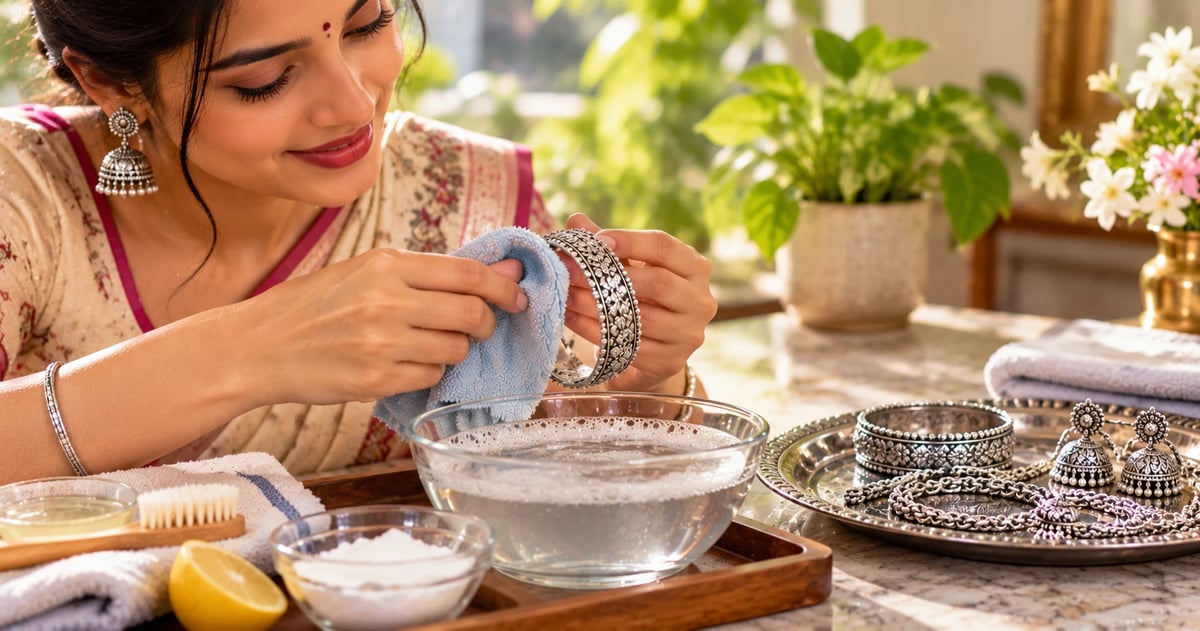
Method 1: Warm Water, Mild Dish Soap and a Soft Brush
Warm soapy water is safe for nearly all silver and handles most routine cleaning. Don't soak pearls or hollow pieces. Wipe those with a damp soapy cloth instead.
Fill a bowl with warm water and add 2 or 3 drops of mild dish soap.
Soak solid pieces for 5 to 10 minutes.
Brush gently with a soft toothbrush around links, clasps and carvings.
Rinse in a second bowl of clean water.
Dry completely with a soft cotton cloth.
The GIA's tips on caring for jewellery suggest rinsing in a glass of water, not over the sink. That way a loose stone can't vanish down the drain.
Method 2: A Silver Polishing Cloth for Light Tarnish
A silver polishing cloth clears light yellowing or greying in a few minutes, with no water needed. It carries a fine polishing compound, so it cleans by very gentle rubbing.
Rub the piece with firm, straight strokes.
Move to a clean patch of cloth as it turns black.
Don't wash the cloth, because washing removes the polish in it.
Keep it out of the grooves on oxidised work, and go lightly on plated pieces.
Method 3: A Degreasing Wash for Ghee and Diya Soot
Ghee, oil and soot are grease, not tarnish, so wash them off before judging how black the silver really is. A diya that looks ruined is often just carbon and old ghee.
Wipe out loose soot and wax with tissue paper.
Soak a solid diya in hot, not boiling, water with dish soap for 15 to 20 minutes.
Scrub the wick groove and base with an old soft toothbrush.
Repeat once if the grease is thick, then rinse and dry.
Check what's left. Only real tarnish needs Method 2, 4 or 5.
A hollow diya, or one with a filled base, shouldn't be soaked. Wipe it with a cloth wrung out in hot soapy water. Kumkum and haldi can stain carvings if left to sit, so rinse them off soon after puja.
Method 4: The Aluminium Foil and Baking Soda Bath
The foil bath turns tarnish back into silver chemically, so it removes black without scrubbing metal away. Use it only on plain, solid silver, such as utensils, plain chains and plain bangles.
Aluminium attracts sulphur more strongly than silver does. Compound Interest's explanation of the tarnish-removal reaction shows it as 3 Ag₂S + 2 Al → 6 Ag + Al₂S₃. Put simply, silver sulphide becomes silver again, and the aluminium keeps the sulphur. Baking soda clears a coating on the foil so the reaction can run. Salt helps the tiny electric current flow.
Line a glass or plastic bowl with aluminium foil.
Sprinkle in about 1 tablespoon of baking soda and 1 teaspoon of salt per litre of water.
Pour in hot water from a kettle, steaming but not boiling, and expect some fizzing.
Lay the silver on the foil so every piece touches it.
After 2 to 5 minutes, lift the pieces out with plastic or wooden tongs.
Wash with dish soap, rinse well and dry.
A rotten-egg smell is normal, as some sulphur escapes as hydrogen sulphide, so open a window.
Is aluminium foil and baking soda safe for silver? Yes for plain, solid silver used occasionally, and no for anything else. Keep it away from oxidised, plated, stone-set, pearl, enamel, hollow or filled pieces. It also can't fix worn-through plating, green copper stains, scratches or dents.
The finish can come out slightly matte. The Canadian Conservation Institute also notes that silver cleaned this way may re-tarnish faster. A quick buff with a polishing cloth helps with both. Once or twice a year is plenty for this method.
Method 5: Silver Polish Cream for Large Plain Pieces
A cream polish made for silver suits big plain surfaces, like a thali or glass with stubborn patches. Polishes clean by fine abrasion, so each use takes off a thin layer. Keep them for a few times a year.
Choose a polish labelled for silver, not a multi-purpose metal polish, which the Canadian Conservation Institute calls more abrasive. Avoid any product listing ammonia. According to the same note, ammonia dissolves copper in 925 silver, and trapped residue can later turn green.
Wash and dry the piece first.
Apply a pea-sized amount with a soft cotton cloth.
Rub with light, even strokes, turning the cloth often.
Wash off every trace with warm soapy water, especially from engraving.
Dry thoroughly.
Method 6: Professional Cleaning and Re-Polishing
A jeweller's clean is the right call for heirlooms, stone-set pieces, hollow idols, oxidised work and anything you're unsure about. A karigar can work around stones, refresh oxidised grooves and buff out scratches that home methods can't reach.
We offer silver cleaning at our Barasat store near Subhash Maidan, where a specialist karigar does the work. Call or WhatsApp +91 9874085669 before you come in.
Which Cleaning Method Suits Which Silver Item?
Match the method to how the piece is built, not to how black it looks. Numbers refer to the six methods above.
Silver item | Safe methods | Avoid |
|---|---|---|
Plain 925 jewellery: silver earrings, silver rings for women, silver chains | 1, 2; 4 now and then | Toothpaste, ash, boiling |
Bangles, kadas and wristlets: silver bangles for women, silver kada, silver wristlets for men | 1, 2; 4 only if solid and plain | Soaking hollow or lac-filled bangles |
Oxidised jewellery | Quick 1 without soaking; 2 on raised areas only | 4, 5, acids |
Stone-set, pearl or enamel pieces, including many silver lockets | 1 without soaking, or 6 | 4, 5, hot water, acids |
Payal with ghungroo: silver anklets | 1 with a brush, 2; 6 for heavy tarnish | Soaking, 4, boiling |
Baby bangles and bowls: silver baby bangles | 1, 2; 4 only if solid and plain | Polish cream, abrasives |
Thali, glass, bati and spoon | 1 after every use; 4 or 5 occasionally | Ash scrubs, leaving polish residue |
Diyas with ghee and soot | 3 first, then 2 or 4 if solid | Soaking hollow diyas |
Hollow or filled idols | Damp soapy wipe, 2, or 6 | Soaking, 4, boiling |
Silver-plated items | 1, light use of 2 | 4, 5, abrasives |
Our guides to silver bangle designs and silver bracelets for men include solid and hollow styles. Check yours before choosing a method. Babies put their bangles in their mouths, so stick to plain soap and a thorough rinse. If your little one also wears gold, see our guide to safe gold earrings and chains for baby girls.
Oxidised Silver: How to Clean It and Keep the Black
To clean oxidised silver without removing the black, wash it briefly in soapy water. Then polish only the raised parts. The dark grooves are deliberate, and they're the same compound as tarnish. Anything that removes tarnish will strip them too, including the foil bath, dips and acids.
Swish the piece in warm soapy water for a minute.
Brush the surface lightly.
Rinse and dry at once.
Wrap a polishing cloth around one finger and rub only the high points.
If the black has worn patchy, a jeweller can re-darken it evenly.
Silver Jewellery With Stones, Pearls or Enamel
Clean stone-set silver with warm soapy water and a soft brush, but don't soak it. Many stones in silver jewellery are glued in or backed with foil, and a long soak can loosen them. Brush from the back of the setting, where grime collects.
For pearls, the GIA suggests a new, soft makeup brush and warm soapy water. Lay them flat on a towel to dry. Put perfume and lotion on before your pearls, never after. Enamel chips easily, so keep abrasives well away from it. Stone-set lockets, like several of our silver pendant designs for women, need this gentler routine.
Silver Payal With Ghungroo Bells
Clean a ghungroo payal with a soapy brush and a quick rinse, never a soak. Each bell is a hollow shell with a loose ball inside. Water that gets in stays there and keeps the inside damp.
Dip a soft toothbrush in warm soapy water.
Scrub the chain links and the outside of each bell.
Dip briefly in a bowl of clean water.
Shake each bell, pat dry, and leave it somewhere warm and airy for a few hours.
Buff with a polishing cloth.
Our guide to silver payal designs for women shows ghungroo and plain styles side by side. For little feet, see the silver anklet designs for baby girls.
Silver Idols, Hollow Diyas and Lac-Filled Pieces
Don't boil silver idols or hollow pooja items, and you don't need to boil solid ones either. Boiling pushes water and baking soda into seams, and heat can soften lac or wax filling. For a solid, plain piece, hot water from a kettle does everything boiling would.
Treat every idol as hollow unless you know it's solid. Dust it with a soft brush first. Then wipe it with a cloth wrung out in soapy water. Follow with a clean damp cloth and dry it well. A polishing cloth on the raised areas finishes the job. Our guide to silver pooja items for the home mandir lists which pieces families usually keep.
Silver-Plated Items and German Silver
Clean silver-plated items with soap, water and the occasional light buff, nothing stronger. The silver layer is thin, and the Canadian Conservation Institute warns that any tarnish removal can damage plating. Once yellow brass shows through, only re-plating brings the silver back.
German silver needs the same gentle wash, then a thorough dry. Green or brown patches on it are copper and nickel corrosion, not tarnish. The foil bath won't touch them.
Are Vibhuti, Tamarind and Toothpaste Safe for Silver?
Traditional methods do remove tarnish, but most work by scraping or by acid. Use them rarely, and never on jewellery with stones.
Vibhuti or wood ash is a fine abrasive. It scrubs tarnish away, along with a little silver. Keep it for a rare scrub on plain, solid items.
Tamarind, lemon with salt, vinegar and ketchup are acidic. Acids dissolve tarnish but can etch the surface, and the Canadian Conservation Institute warns that acid dips can pit silver. Rinse within minutes, then wash with soap.
Toothpaste can clean silver, but it contains abrasives, and whitening pastes are harsher. It leaves fine scratches that dull the surface over time.
A baking soda paste is a mild abrasive. It's acceptable on plain, solid pieces now and then.
Our view is simple. Treat these as strong methods, not gentle ones, and keep them off oxidised, plated, pearl and stone-set pieces.
How to Clean Silver Utensils Used for Food
Wash silver thalis, glasses, batis and spoons used for food with dish soap after every use. Dry them straight away to avoid water spots. Salt, egg, lemon and pickle speed up tarnish, so don't leave food sitting in silver.
After a foil bath or polish cream, wash the piece twice with dish soap and hot water. Rinse well and dry. We couldn't find authoritative guidance on foil-bath residue on food utensils, so don't skip the second wash.
Browse our silver thalas, silver glasses, silver batis and silver spoons, or the full range of silver items. For a plate too scratched or dented to enjoy, our silver plate price guide shows the per-gram maths.
How Often Should You Clean Silver?
Clean silver you use lightly every week, and deep-clean only when gentle methods stop working.
Daily-wear jewellery and payals: wipe after wearing, then a soapy wash once a week.
Pooja items: wipe after each puja, then a soapy wash monthly or before festivals.
Utensils: wash after every use.
Foil bath: once or twice a year, for solid pieces only.
Polish cream: a few times a year, on large plain pieces.
The GIA recommends having jewellery checked by a professional every six months. That's a sensible rhythm for heirlooms and stone-set silver.
How to Store Silver to Prevent Tarnish in Humid Weather
Airtight storage prevents most tarnish, which means less cleaning and less silver lost. The Canadian Conservation Institute recommends sealing silver in polyethylene bags, ideally with silica gel and activated charcoal.
Dry every piece completely before storing it.
Seal each piece in its own zip bag and press out the air.
Add an anti-tarnish strip or a silica gel sachet to each bag.
Wrap pieces in acid-free tissue or a cotton pouch inside the bag, never wool or felt.
Keep rubber bands away from silver entirely.
Keep the mandir set away from the stove, if your home allows it.
During the monsoon, check bags every few weeks and replace damp sachets. The box your piece comes in from us protects it from scratches. In humid months, seal the piece in a zip bag before it goes back in the box. A silver rakhi kept as a keepsake after Raksha Bandhan deserves the same bag. More care and buying guides sit in our silver guides section.
When to Bring Silver to a Jeweller
Bring silver to a jeweller whenever it's too risky to clean silver at home. That includes:
An heirloom, or any piece with loose stones.
A hollow idol with black deep inside the seams.
Oxidised work that has worn patchy.
Plating worn through to brass.
Deep scratches, dents or broken joins.
Green patches that keep coming back.
You can visit our Barasat store near Subhash Maidan, or call or WhatsApp +91 9874085669 first. Common store questions are answered on our FAQ page.