


Silver Plate Price Today: Easy Per-Gram Math (2026)
 Sujoy Dhar
11 min read
Key takeaways
A silver plate's price is net weight × purity × the day's rate, plus making charges and 3% GST. Most silver utensils are 925 sterling silver, which is 92.5% silver. At the 1 October 2026 IBJA rate, 100 g of 925 silver holds approx. ₹20,427 of metal. Silver hallmarking is voluntary, but any hallmarked piece must carry a HUID.
A silver plate price is its net weight × purity × today's silver rate, plus making charges and 3% GST. On 1 October 2026, the IBJA benchmark for 999 silver closed at ₹220.83 per gram, before GST. That puts the metal in 925 sterling silver at approx. ₹204.27 per gram. So a 134.77 g sterling thala holds approx. ₹27,529 of silver before making and GST.
This guide is for families buying a thala, bati, glass or spoon for an annaprashan, wedding, puja or gift. It shows the math for each item, so you can check any quote line by line.
How Is the Price of a Silver Plate Calculated?
Every silver utensil is priced in five steps: weight, purity, rate, making charges and GST. Here's what each one means.
Net weight. This is the silver alone, without stones, lacquer or wax filling. Gross weight is everything on the scale. On a plain plate, both are usually the same.
Purity. A 925 piece is 92.5% silver, so you multiply the weight by 0.925. A 999 piece uses 0.999.
Today's rate. Shops start from the day's 999 rate per gram. Check our live gold and silver rate board before you visit.
Making charges. This is the labour for shaping, engraving and polishing. Some shops charge per gram, others charge a flat amount per piece.
GST. Silver articles attract 3% GST, as this guide to GST rates on silver articles explains.
Here's the full math for one real piece, the Floral Glow Silver Glass (S/63/10).
Line | Figure |
|---|---|
Net weight | 88.09 g |
Purity | 92.5% (925 sterling) |
Fine silver content | 88.09 × 0.925 = 81.48 g |
Rate (IBJA 999, 1 Oct 2026) | ₹220.83 per gram |
Metal value | approx. ₹17,994 |
Making charges | Varry according to product and weight |
GST at 3% | 3% of (metal value + making charges) |
Per gram or per piece matters. Per-gram making grows with weight, so heavy plates cost more in labour. Per-piece making favours heavy, plain items. Always ask which one the shop uses, and get it printed on the bill.
Silver Plate Price by Item: Weights and Metal Value
Weight drives most of the silver plate price, and weights vary widely even within one item type. A silver plate price per gram quote means little until you know the net weight. The table below uses net weights from our own product pages, all in 925 sterling silver.
Item | Weight range in our range | Metal value at ₹204.27/g (approx.) |
|---|---|---|
Silver thala (plate) | 18.89 g to 408.2 g | ₹3,859 to ₹83,382 |
Silver glass | 14.69 g to 90.07 g | ₹3,001 to ₹18,398 |
Silver bati (katori) | 12.95 g to 58.63 g | ₹2,645 to ₹11,976 |
Silver spoon (chamach) | 9.02 g to 20.96 g | ₹1,842 to ₹4,281 |
These figures cover metal only, at the 1 October 2026 IBJA rate. Making charges and 3% GST come on top. Weights are taken from Biswakarma product pages checked on 4 October 2026.
Silver Thala or Plate Weight and Cost
A silver thala's cost, called the silver thali price outside Bengal, depends mostly on the sheet weight. Our S/61/12 Lotus Frame Silver Thala weighs 134.77 g in 925 silver. Its metal value is approx. ₹27,529 at today's rate.
How much does a 500 gram silver plate cost? In 925 silver, the metal alone comes to approx. ₹1,02,133. In 999 silver, it's approx. ₹1,10,304. Add making charges, then 3% GST.
Size and weight don't always move together, though. A thick, plain 8-inch thala can outweigh a thin, engraved 10-inch one. Browse every size in our silver thala collection.
Silver Glass Weight and Cost
A silver glass price is usually lower than a plate's, because a glass uses less metal. Our glasses run from 14.69 g to 90.07 g. A 100 g glass in 925 silver holds approx. ₹20,427 of metal; in 999, approx. ₹22,061.
Small glasses suit a baby's first rice meal. Taller ones, closer to 90 g, are the usual wedding or housewarming gift. Compare them in our silver glass collection.
Silver Bati or Katori Weight and Cost
A silver bati, or katori, is the lightest bowl you can buy in solid silver. Ours start at 12.95 g, so the silver katori price begins at approx. ₹2,645 in metal. The S/62/20 Floral Rim Silver Bati weighs 53.58 g, worth approx. ₹10,945 in metal.
Deep bowls with thick rolled rims weigh more. Still, that rim makes the bowl sturdier for daily use. See the full silver bati range.
Silver Spoon Weight and Cost
A silver spoon price is the lowest entry point into solid silver utensils. Ours weigh between 9.02 g and 20.96 g. At today's rate, that's approx. ₹1,842 to ₹4,281 in metal.
For a baby, a 9 to 12 g spoon is easier for little hands. The Floral Path Silver Spoon (S/64/12) weighs 20.79 g, closer to adult size. More shapes sit in our silver spoon collection.
How Much Does an Annaprashan Silver Set Cost?
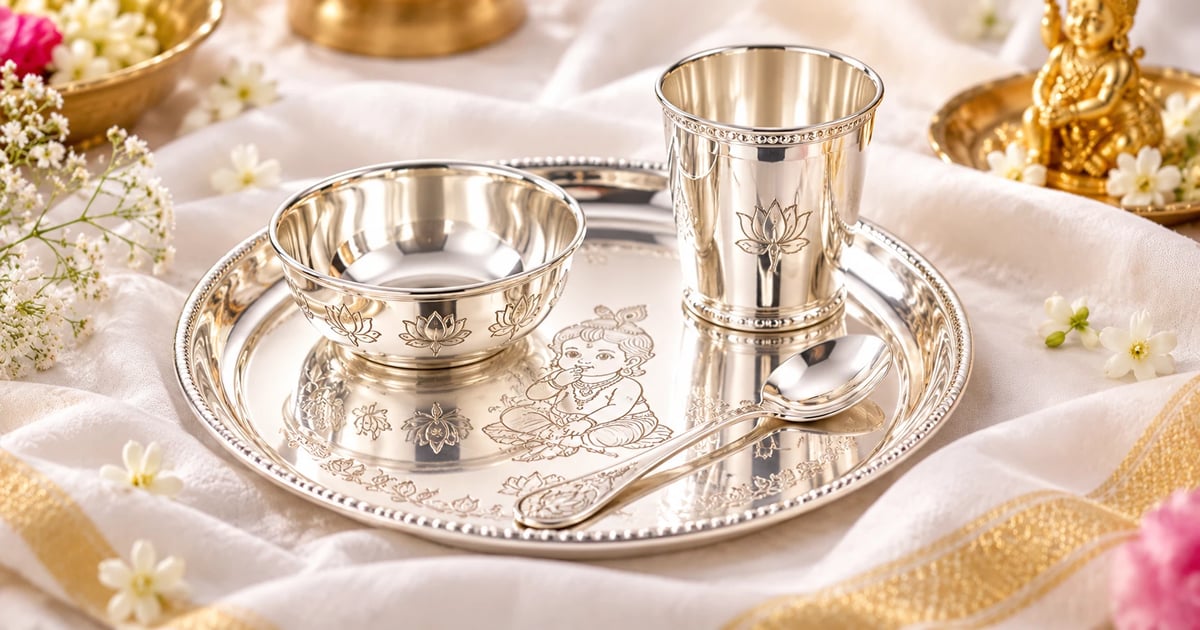
Our two sample annaprashan sets hold approx. ₹15,647 and ₹60,714 of silver at today's rate. Making charges and GST come on top. In Bengal, silver utensils for annaprashan (mukhe bhaat) come as a thala, a bati, a glass and a spoon.
Here are two real combinations from our range, metal value only:
Set | Pieces (SKU and net weight) | Total weight | Metal value (approx.) |
|---|---|---|---|
Light set | Thala S/61/23 (23.93 g), bati S/62/28 (18.84 g), glass S/63/20 (21.71 g), spoon S/64/36 (12.12 g) | 76.6 g | ₹15,647 |
Heavier set | Thala S/61/12 (134.77 g), bati S/62/20 (53.58 g), glass S/63/10 (88.09 g), spoon S/64/12 (20.79 g) | 297.23 g | ₹60,714 |
Need only a bowl and spoon? Our lightest bati and spoon together weigh 21.97 g. That's approx. ₹4,488 in metal.
For a rice ceremony, a 7 to 8 inch thala is plenty. The baby eats a few grains, and the plate mostly stays in the family cupboard. A lighter set still looks complete in photos, because guests see the four pieces, not the scale. Spend more only if you plan to use the plate for adult meals later.
Shop each piece from our silver thala, silver bati, silver glass and silver spoon collections. Many families add a pair of silver baby bangles or silver anklets. For anklet styles, see our guide to silver anklets for baby girls. If grandparents prefer gold, our baby gold chain guide covers safe weights.
925 vs 990 vs 999: Which Purity Suits Utensils?
For utensils you'll use, 925 sterling silver is the practical choice because it resists dents better. It's 92.5% silver and 7.5% other metal, usually copper. 999 is fine silver, which is softer and scratches more easily.
Here's the price gap, then. In 999, the same weight costs about 8% more in metal. For our 134.77 g thala, that's approx. ₹29,731 instead of ₹27,529.
So which should you pick? Choose 999 if the piece will mostly sit in a cupboard and you care about resale. Choose 925 for anything that goes near a dining table. 990 sits in between and is less common in utensils.
One honest note: every utensil currently listed on our site is 925. If you want 999, ask before you visit. And never let a seller call 925 "pure silver"; it is sterling. Our 925 vs pure silver guide explains the difference in jewellery terms. The metal guide shows how our rate labels map to each purity.
Solid Silver or Silver-Plated: How Can You Tell?
A silver-plated plate is base metal with a microscopic silver coating, and it has almost no resale value. Plated pieces are often stamped "EP" or "EPNS", short for electroplated nickel silver. Despite the name, nickel silver contains no silver at all. It's a copper, nickel and zinc alloy.
Run these checks before you pay:
Look for the BIS mark with the word SILVER, a purity number and a six-character HUID.
Check rims and the base for a yellow or pink tone showing through. That's base metal.
Compare the price with the metal math above. A "silver" thala at a fraction of the metal value is plated.
Ask the shop for an XRF test, a quick non-destructive purity scan.
A magnet test only helps a little. Silver isn't magnetic, but neither are brass and copper. Use it to rule out steel, nothing more.
Is Silver Hallmarking Mandatory? How to Check a HUID
Silver hallmarking in India is still voluntary as of October 2026. A HUID (unique six-character hallmark code) is compulsory only when a piece is hallmarked. In June 2026, the BIS Director General said BIS is studying how to make silver hallmarking mandatory gradually. No date has been set.
Since 1 September 2025, a hallmark has three parts. These are the BIS Standard Mark with the word SILVER, the purity grade, and the HUID. The revised BIS standard, IS 2112:2025, recognises seven silver purity grades. They are 800, 835, 925, 958, 970, 990 and 999.
To verify a piece, install the BIS CARE app and open "Verify HUID". Type the code engraved on the plate. The app should show the article type, purity, hallmarking date, jeweller registration and testing centre. If the purity shown doesn't match the bill, don't pay.
Older silver may carry the earlier four-part hallmark, which has no HUID to scan. That doesn't make it fake. It just means you can't check it on the app. For how the same system works on gold, read our hallmark gold vs BIS gold guide.
Why Is Silver So Expensive in 2026?
Silver costs more in 2026 mainly because of higher import costs and a sharp run-up in global prices. On 13 May 2026, India raised the import duty on gold and silver from 6% to 15%. Days later, the government also moved silver imports to a restricted list needing a licence.
The jump is easy to see in rupees. Business Standard's Mumbai data shows silver at ₹1,22,800 per kg on 1 September 2025. IBJA's 999 rate closed at ₹2,20,829 per kg on 1 October 2026. That's about 80% higher in thirteen months.
Prices also move daily, in both directions, so date every quote you collect and compare quotes from the same day. Gold carries the same 15% duty, and our article on whether gold prices will rise or fall covers that side.
How to Clean Tarnished Silver Utensils Safely
Tarnish is a dark film that forms when silver reacts with sulphur in the air. It wipes off, and it doesn't mean the silver is fake.
Wash in warm water with a little mild dish soap, using a soft sponge.
Dry at once with a soft cotton cloth, so water spots don't form.
Rub light tarnish away with a silver polishing cloth.
Store each piece in a zip pouch, away from rubber bands, which speed up tarnish.
Skip steel wool, scouring powder and bleach, because they scratch the surface and can strip engraving. Egg yolk and onions also darken silver quickly, so rinse plates soon after meals. For heavy tarnish, we offer complimentary lifetime cleaning and polishing at our showroom.
Do Silver Utensils Keep Resale or Exchange Value?
Yes, solid silver utensils keep their metal value, but you won't get making charges or GST back. Resale value is the fine silver content multiplied by the buyer's rate on the day you sell. For the 88.09 g glass above, that's 81.48 g of fine silver.
At Biswakarma, a gifted gold or silver piece can be exchanged by the person who received it. The buyer doesn't need to come, and no bill or HUID is required. There's no time limit. Making charges and GST are deducted, so you get the metal value.
Silver-plated items are different, though. Their silver layer is too thin to be worth recovering, so most buyers treat them as base metal. That's one more reason to keep the bill showing net weight and purity.
Five Checks Before You Pay for Silver Utensils
Five quick checks protect you from the three common problems: wrong purity, missing weight and hidden charges.
Ask for the day's rate and note the date on the quote.
Read the net weight on the scale yourself.
Confirm the purity in writing: 925, 990 or 999.
Get making charges as a separate line, per gram or per piece.
Check the HUID on the BIS CARE app if the piece is hallmarked.
Buying silver as a gift for a couple instead? Our wedding gift ideas in gold and silver and anniversary jewellery gifts for a wife offer lighter options. Every buying guide sits under our silver guides, and the full range is in silver items.