


Gold Purity Chart: 24K, 22K, 18K, 14K Karat & Fineness

Key takeaways
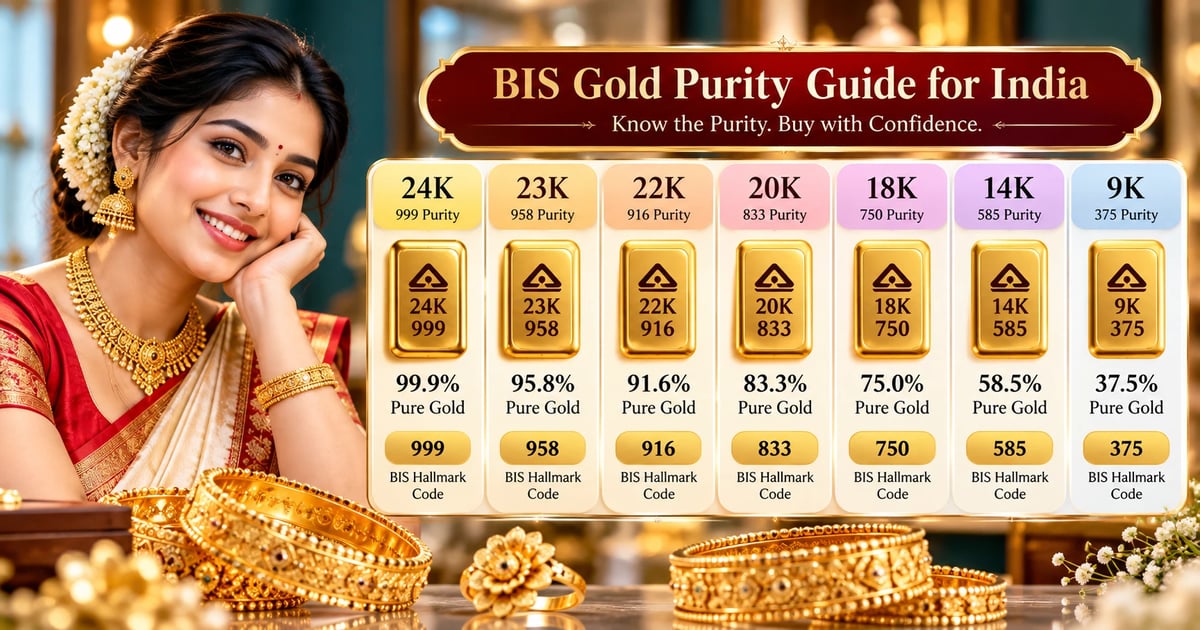
A gold purity chart converts karat into real gold content. 24K is 99.5% to 99.9% gold, 22K (916) is 91.6%, 18K (750) is 75% and 14K (585) is 58.5%. In India, BIS hallmarks 14K, 18K, 20K, 22K, 23K and 24K, while 9K is voluntary. Price per gram should fall in step with purity.
This gold purity chart shows how much real gold sits in each karat sold in India. 24K is 99.5% to 99.9% gold, 22K is 91.6% (stamped 916), 18K is 75% (750) and 14K is 58.5% (585). Karat, percentage and fineness are three labels for one number.
BIS hallmarks six karats in India, plus a voluntary 9K grade, and every one is genuine gold. Use the chart before you buy jewellery, read a hallmark or exchange old gold. That way, the price you pay matches the purity you get.
India's Gold Purity Chart: Every BIS Grade and Price
Seven grades can carry a BIS hallmark in India, and each one has its own rate per gram.
Karat | Hallmark code | Gold % | Other metals % | Approx. price per gram (5 Oct 2026) | Common uses |
|---|---|---|---|---|---|
24K | 24K995 (999 on many coins and bars) | 99.5 to 99.9 | 0.1 to 0.5 | ₹14,918 | Coins, bars |
23K | 23K958 | 95.8 | 4.2 | ₹14,291 (est.) | Uncommon in shops |
22K | 22K916 | 91.6 | 8.4 | ₹13,675 | Pola, churi, chains, mangalsutra, gifting coins |
20K | 20K833 | 83.3 | 16.7 | ₹12,427 (est.) | Less common jewellery |
18K | 18K750 | 75.0 | 25.0 | ₹11,189 | Diamond and stone settings, daily rings |
14K | 14K585 | 58.5 | 41.5 | ₹8,727 (est.) | Light everyday pieces |
9K | 9K375 (voluntary) | 37.5 | 62.5 | ₹5,594 (est.) | Budget pieces (voluntary grade) |
Rates as of 5 October 2026. They are Kolkata retail board rates per gram, before making charges and GST. The 24K, 22K and 18K figures are published rates. Rows marked (est.) are our own maths: 24K rate × fineness ÷ 1,000. Rates move daily, so check the live gold rate on our rate page. You can also run your own weights through our gold price calculator.
These grades come from IS 1417, the Indian standard for gold fineness and marking. The Bureau of Indian Standards' hallmarking explainer lists the six mandatory caratages. It also gives sample codes such as 22K916, 18K750, 14K585, 20K833 and 23K958. Its 24K example is 995.
Hallmarking is mandatory only in notified districts, not across the whole country. The sixth phase took coverage to 380 districts, according to All India Radio's March 2026 report on the expansion. In that same statement, BIS described 9K as a voluntary grade.
How Do You Read Karat, Fineness and Percentage?
Divide the karat by 24 and you get the share of pure gold. For 22K, that's 22 ÷ 24 = 0.916, or 91.6%.
Fineness (gold parts per thousand) is the same figure without the decimal. So 91.6% becomes 916, and 75% becomes 750. Percentage is just fineness divided by 10.
Read a hallmark code the same way. 22K916 means 22 karat, with 916 parts of gold in every 1,000. 24K999 means 999 parts per 1,000, which is as close to pure as gold gets. The karat and the number always agree, because they describe one fact.
One spelling note. Karat (purity) is often written "carat" in India. On a diamond, though, carat means weight, not purity.
24K Gold (995/999): Coins, Bars and Pure Gold
24K is the purest gold you can buy, and in India it's sold mostly as coins and bars. Bullion (investment coins and bars) is usually 995 or 999 fine. Because almost nothing is mixed in, the price tracks the gold rate closely.
Why Isn't 24K Gold Used for Most Jewellery?
Pure gold is too soft to keep its shape through daily wear. BIS says this plainly in its hallmarking explainer: jewellery gold is always alloyed with other metals for strength.
A 24K ring scratches and bends easily. Prongs can't grip a stone for long, and thin links stretch. That doesn't make lower karats poor quality. It makes them practical.
22K Gold (916): India's Jewellery Standard
916 on gold jewellery means 91.6% pure gold. So 10 g of 22K jewellery holds about 9.16 g of pure gold. The other 0.84 g is alloy that adds strength.
22K keeps the deep yellow colour most Indian families expect. It also holds fine detail well, so it suits traditional work. Think of pola bangles and the tradition behind them, or a 22K gold mangalsutra and its price range. You can browse our gold pola collection to see 22K work up close.
Our gifting coins are 22K too. The Lakshmi gold coin weighs 3.91 g, and the Gini gold coin weighs 2.75 g. If you'd rather wear the coin, read our gini ring guide on meaning and designs.
22K has one honest weakness. For a daily chain or a ring you never take off, it's soft enough to dent. 18K holds up better there.
18K Gold (750): The Grade for Diamond Settings
18K is 75% gold, and that extra 25% alloy makes it firm enough to hold diamonds securely. It's the usual choice for stone-set rings and earrings, and for white or rose gold.
You can compare styles in our diamond earrings buying guide and our guide to diamond rings for men. To shop, see our diamond rings for women and diamond earrings.
Watch the rate on the bill. On 5 October 2026, a gram of 18K cost ₹2,486 less than 22K. Paying 22K rates for an 18K piece would overcharge you ₹24,860 on 10 g.
14K Gold (585): Why It's 585 and Not 583
14K jewellery is stamped 585, meaning 58.5% gold, and it is a BIS-hallmarked grade in India. By the formula, 14 ÷ 24 gives 0.583, so 583 looks correct.
The World Gold Council's page on carat and purity explains the gap. Strictly, 14K should be 583. Most makers follow European practice and make it slightly over 14K, so the mark reads 585. The 585 stamp is not a mistake.
14K suits light pieces you wear every day. It's harder than 22K and costs far less per gram. We stock 14K pieces such as ticklis. For ideas, see our 14K gold necklace designs and prices and our lightweight necklace weight guide.
Buyers are moving this way. The World Gold Council's Gold Demand Trends India report for Q2 2026 notes a shift to lighter, lower-carat jewellery. The trade-off is real, though. 14K looks paler, and less gold means less value when you exchange it.
What Are 23K958, 20K833 and 9K375 Gold?
23K958 is 95.8% gold, 20K833 is 83.3% gold, and 9K375 is 37.5% gold. You'll see these less often than 22K or 18K.
23K sits just below pure gold. It's soft and uncommon in shops, but it's a full BIS grade.
20K is a mandatory BIS grade, though few shops carry it. If your old piece reads 20K833, it's genuine gold at 83.3%.
9K can be hallmarked in India, but only as a voluntary grade. It isn't banned, and it isn't mandatory either.
Global charts often list 10K too. 10K is not an Indian hallmark grade, so ignore it when you read a BIS mark.
What Metals Are Mixed Into Gold Jewellery?
Silver, copper and zinc make up the non-gold share in most yellow gold. The mix also decides the colour.
World Gold Council figures give one typical 22K yellow mix: 91.7% gold, 5% silver, 2% copper and 1.3% zinc. A typical 18K yellow alloy carries 15% silver and 10% copper. These are common recipes, not the only ones.
Colour changes with the alloy. More copper turns gold rose, and an 18K rose mix can carry about 22% copper. White gold uses palladium or silver, and is often plated with rhodium for shine. Our metal guide covers how each metal behaves.
More alloy also means more hardness. That's why 18K and 14K resist scratches better than 22K.
Silver follows the same parts-per-thousand logic. The number stamped on silver bangles, a silver bracelet for men or a silver pendant for women is fineness too. Silver has its own BIS grades, from 999 down to 800.Buying a silver plate, glass and bowl set or silver pooja items for the home mandir? Ask for the fineness on the bill, since the rate per gram depends on it.
Gold Price by Karat: How to Calculate It Yourself
Multiply the 24K rate by the fineness, divide by 1,000, then multiply by the weight. That gives the gold value of any piece, using the fineness from the gold purity chart above.
Take an 8 g pair of 18K earrings. At ₹14,918 for 24K: 14,918 × 750 ÷ 1,000 × 8 = ₹89,508. Boards set 22K and 18K rates separately, so your answer may differ by a few rupees.
Worked Example: Pricing a 10 g 22K Gold Chain
Start with the gold value. 10 g × ₹13,675 = ₹1,36,750.
Next, add making charges. Say they come to ₹12,000; that's an example, not a quote. The subtotal is ₹1,48,750.
Then add 3% GST on that subtotal, which is ₹4,463. The bill comes to about ₹1,53,213.
Our gold calculator does this maths for any weight and karat.
Which Karat Should You Choose for Each Piece?
Choose 22K for traditional jewellery, 18K for stones and hard-wearing rings, and 14K for light daily pieces.
What you're buying | Good fit | Trade-off to know |
|---|---|---|
Coins and bars | 24K, or 22K for gifting coins | 24K is too soft to wear |
Pola, churi, mangalsutra | 22K | Dents with rough daily use |
Diamond ring or earrings | 18K | Less gold per gram than 22K |
Daily-wear chain | 18K or 22K | 22K links can stretch over time |
Light pendant or tickli | 14K | Paler colour, lower exchange value |
Baby girl's first earrings | 22K or 18K | Tiny studs wear lightly, so colour can lead |
For chains, start with our gold chains for women, or our guide to gold chains under 10 grams. For little ones, see our gold earrings for baby girls.



Wearing gold every day is a choice many families make for reasons beyond value. Our post on the benefits of wearing gold covers that side. If resale value per gram matters most to you, 14K is the wrong fit.
Which Karat Has the Best Resale or Exchange Value?
Higher karats return more rupees per gram, because each gram holds more gold. 24K and 22K lead, and 14K trails.
Exchange value usually works like this: net gold weight × purity × the buying rate. Stones come off the weight first. Making charges and GST paid on the old bill don't come back.
So for equal pure gold content, the karat matters less than the hallmark and the deductions. No jeweller can guarantee a resale price for any karat, because the gold rate moves.
At our store, we deduct stone weight, making charges and GST when we value a piece. Our FAQ page answers common exchange questions.
Quick Hallmark Check Before You Buy Gold
A current BIS hallmark has three marks: the BIS logo, the purity code (for example 22K916) and a six-character HUID. Hallmarks made before 1 July 2021 carried four marks instead.
Check the HUID with the Verify HUID feature in the BIS CARE app. For the full steps, use our gold purity check before buying and our guide to hallmark gold vs BIS gold. More reading sits in our gold buying guides.