


14K Gold Necklace: Designs, Prices & Honest India Guide
 Sujoy Dhar
8 min read
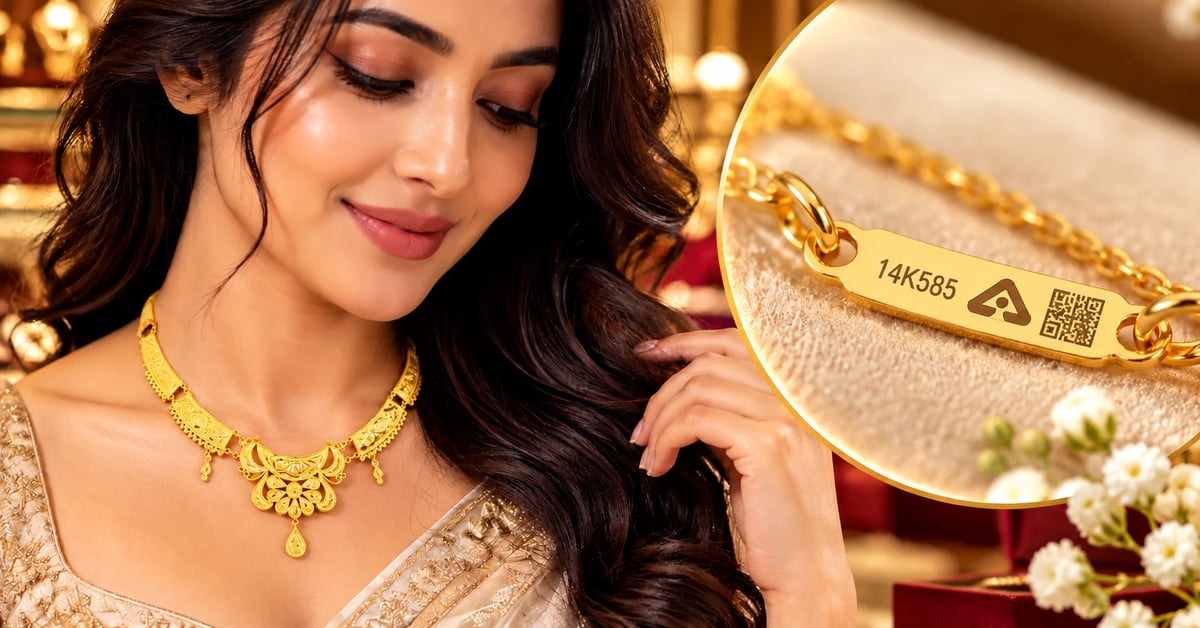
At IBJA's 24K rate of ₹15,334 a gram on 22 September 2026, many buyers price a 14K gold necklace first. The World Gold Council's Q2 2026 India report says high prices sped up a shift to lighter, lower-carat jewellery. For first-time buyers, the first worry is simple. Is it real gold?
It is. A 14K necklace holds 58.5% pure gold. A genuine piece carries a BIS hallmark reading 14K585, plus a six-character HUID code.
The trade-off is simple. 14K costs less per gram and resists dents better than 22K. But it's a daily-wear metal, not a wedding-set substitute.
14K Gold Necklace Basics: 58.5% Gold, Stamped 585
A 14K gold necklace is real, solid gold with 58.5% pure gold content. The other 41.5% is alloy, usually copper, silver and zinc. In India, BIS permits 14K as a hallmark grade under IS 1417:2016. A genuine piece carries three marks: the BIS logo, 14K585 and a six-character HUID.
Karat (purity out of 24 parts) explains the name. Fourteen parts out of 24 works out to about 58.3%. The Indian standard sets the 14K grade at 585 parts per thousand, so that's the number stamped.
One forum post claims anything below 22K is fake gold. That's wrong. The BIS hallmarking FAQ lists six gold grades it will hallmark: 14K, 18K, 20K, 22K, 23K and 24KS. 14K is simply the lowest of them. So a piece sold as 9K or 10K can't carry a BIS gold hallmark at all.
You'll also see it sold as a 14 carat gold necklace or a 14kt gold necklace. Same metal, same 585 mark. So a 585 hallmark gold necklace is simply a 14K piece. A 14K solid gold necklace is gold alloy all the way through. Plated jewellery is base metal with a thin gold skin. Our guide to real gold vs plated jewellery shows how to tell them apart.
Lookout for our Bridal Collection Guide !
14K vs 18K vs 22K Gold for a Necklace
Each purity does a different job. Here's how they compare on the numbers that matter. Metal rates below use IBJA's 999 rate of ₹15,334 per gram on 22 September 2026. They exclude making charges and GST.
14K | 18K | 22K | |
|---|---|---|---|
Pure gold content | 58.5% | 75% | 91.6% |
Purity mark on the hallmark | 14K585 | 18K750 | 22K916 |
Metal-only rate per gram, 24K × purity (22 Sept 2026) | about ₹8,970 | about ₹11,501 | about ₹14,046 |
Hardness | Hardest of the three | Middle | Softest |
Colour | Paler yellow | Warm yellow | Deep yellow |
Best job | Daily chains, pendants, stone settings | Diamond jewellery, fine chains | Wedding sets, traditional designs |
So is a 14K gold necklace good for daily wear? Yes, and that's its main strength. More alloy makes the metal harder, so thin links kink and stretch less. That same hardness grips stones in a pendant more firmly.
22K wins on colour and on tradition. It's the right pick for a wedding set or a piece bought partly as family gold. 18K sits in between, and it's common in diamond jewellery. For thin chains in 18K and 22K, our lightweight necklace price and weight guide covers the trade-offs.
14K Gold Necklace Designs Worth Buying
These seven designs play to what 14K does well. For more looks at every purity, see our small gold necklace designs for daily wear.
You can check our Tie Chain Collections Article !
How Many Grams a Daily-Wear 14K Necklace Needs
A lightweight 14K gold necklace for daily use usually stays under 15 g. We group lightweight necklaces into three bands: under 5 g, 5–10 g and 10–15 g. A fine chain alone sits under 5 g. A chain with a small pendant usually lands in the 5–10 g band.
Box Chain With a Small Pendant
Square links make a box chain hold its shape well. It carries a light pendant without twisting.
Cable Chain for Everyday Layering
A plain 14K gold chain necklace with oval links is easy to wear and easy to repair. A cable chain also layers neatly with a second, longer chain.
Rope Chain for a Fuller Look
Twisted links catch more light. As a result, a rope chain reads as bolder than a flat chain of the same weight.
Locket or Pendant Necklace
A 14K gold pendant necklace suits a name, initial or small religious motif. Remember that a detachable pendant needs its own hallmark.
Lab-Grown Diamond Pendant in 14K
Stones need firm prongs, and soft 22K prongs can bend. That's why a 14K gold necklace with a lab-grown diamond pendant makes sense. Check that the bill lists gold weight separately from stone weight.
14K White Gold Chain
White gold is usually coated with rhodium, a bright white metal. The coating wears over time and can be redone. Ask what the alloy contains before you buy.
Short Collarbone Necklace for Office Wear
A short chain that sits on the collarbone stays out of the way at a desk. Pair it with a tiny motif, not a heavy drop.
14K Gold Necklace Price in India, Worked Out
No fixed price stays true for long, because the gold rate moves daily. Instead, use this formula with the day's rate:
24K rate × 0.585 = the 14K metal rate per gram.
Net gold weight × 14K rate = metal value.
Add the making charges.
Add 3% GST on the total.
Check the gold rate in Kolkata today before you start. Then run your own numbers in our gold jewellery bill calculator.
Worked Example Using the 22 September 2026 Rate
Say you like a 6 g chain with a small pendant. We'll assume 15% making charges. That's an example figure, not a quoted rate.
14K rate: ₹15,334 × 0.585 = ₹8,970 per gram (metal only)
Metal value: 6 g × ₹8,970.39 = ₹53,822
Making charges at 15%: ₹8,073
Subtotal: ₹61,895
GST at 3%: ₹1,857
Total: ₹63,752
For comparison, the same 6 g piece in 22K would cost about ₹99,825 on those terms. That uses IBJA's 916 rate of ₹14,046 that day. Your jeweller may quote its own 14K rate, so ask which base rate it used.
What a ₹30,000 Budget Buys in 14K
On those terms, each gram costs about ₹10,625 all-in. So a 14K gold necklace under ₹30,000 means roughly 2.8 g of gold or less. That's a fine chain, or a slim chain with a very small pendant. Light pieces often carry a higher making percentage, which shrinks that weight further.
Making Charges and GST: What Your Bill Should Show
Some blogs say you pay 3% GST on gold and 5% on making charges. That isn't how the retail bill works. The GST Council's gems and jewellery FAQ says GST is 3% of the total transaction value. It applies whether or not making charges are shown separately. The 5% rate is for job work charges between registered businesses.
BIS also says your bill should carry the details of the hallmarked item. Ask for net weight, purity, rate per gram, making charges and HUID on separate lines.
You can check our Red Crystal Necklace Collections !
How to Check a 14K585 Hallmark and HUID
A hallmark is the official purity stamp. Since 1 July 2021, it has three parts: the BIS logo, the purity mark and the HUID. Older price guides still describe five marks, including a jeweller mark and a year code. Those no longer apply to new pieces.
Find the marks. Look near the clasp for the BIS logo, "14K585" and a six-character code of letters and numbers. BIS requires registered jewellers to keep a 10X magnifier, so ask to use it.
Check every detachable part. BIS says each detachable part needs its own hallmark with a different HUID. On a necklace, that usually means the pendant too.
Verify the HUID. Open the BIS Care app and use its "Verify HUID" feature. Then compare the result with the piece and your bill.
Keep the bill. You'll need it for any complaint or exchange later.
Test it if you doubt it. BIS-recognised assaying and hallmarking centres will fire-assay a piece. BIS lists the fee as ₹200.
Mandatory hallmarking covers specific districts, not the whole country. By the 8th phase on 3 August 2026, the BIS phase-wise district list reached 392 districts. Kolkata and North 24 Parganas were in the first phase, from 23 June 2021. Even so, insist on the hallmark wherever you buy.
For the difference between terms like "hallmark gold" and "BIS gold", read our hallmark gold vs BIS gold explainer.
Care and Skin Reactions With 14K Gold
In a 14K necklace, 41.5% of the metal is alloy. That matters if your skin reacts to jewellery. Mayo Clinic's nickel allergy guidance lists 18-, 22- and 24-karat yellow gold among safer choices. It also names nickel-free white gold. 14K isn't on that list.
That doesn't mean 14K will cause a reaction. It means you should ask the jeweller for the exact alloy composition first. If a rash appears after wearing any piece, take it off and see a doctor.
Cleaning is simple. Soak the chain in warm water with a drop of mild soap. Then brush gently with a soft toothbrush, rinse and pat it dry. Store each chain closed and apart from others, so the links don't tangle.
Who Should Buy 14K and Who Should Skip It
14K is a good fit if:
You want a 14K gold necklace for daily wear that holds its shape through office days.
You're buying a gift on a fixed budget and need real, hallmarked gold.
Your pendant has stones that need firm prongs.
You're better off in 22K or 18K if:
You're buying for a wedding. Our long gold necklace designs for brides guide covers that.
You want gold mainly as savings. Each gram carries less gold, and making charges take a bigger share.
You've reacted to jewellery before and can't get the alloy details.
Ready to compare pieces? Browse the gold chains collection or our other necklace buying guides.