

Gold Thumb Ring: Complete Designs & Sizing Guide
 Sujoy Dhar
11 min read
Sujoy Dhar
11 min read
A gold thumb ring is a band for the thumb, typically 3 mm to 8 mm in width. They usually weigh somewhere between 1.5 and 4 grams in 22K. The thumb is usually 2 to 4 sizes bigger than the ring finger. It has to be measured separately, or else it will simply spin.
The last one leads to more returns than any design choice does. That’s why this guide focuses on weight and size before moving to the outside in.
One choice is worth settling on before jumping into the article. There is no classical Indian source that forbids a ring on the thumb, and the popular rumors contradict each other. You are free to make a choice.
What a gold thumb ring actually means
Very little, historically. The less confident answer is more honest.
The archer's ring is the component with evidence
There is one documented Indian thumb ring, and it isn't jewellery in origin.
In Indian archery the thumb hooks around the bowstring to draw the bow, and the Met's 19th-century Indian archer's ring in jade, gold, rubies and emeralds, was worn to protect the inside of the thumb.
Rank was a factor. These rings featured fine inlays that signalled social status, so they served as costume as well as equipment.
That's the real lineage. Not "ancient Greece", as appears on an unnamed source on the internet.
Exclusive : Best Gold Gents Ring for Men
Why the astrology answers contradict each other
Search "which finger for a gold ring" and you'll find three different answers.
Some Indian jewellery sites claim the thumb represents willpower. Vedic astrology guides say the opposite: thumb rings aren't traditional, there's no classical text that supports them, and the thumb has no assigned planet. At least one warns against wearing gold there specifically.
They can't all be right. What they have in common is not citing a scripture.
So treat these as folk claims of fairly recent vintage. If an elder of your family holds a firm view, that's worth respecting as family custom. It isn't a rule you're breaking.
5 gold thumb ring designs, sorted by gram weight
A thumb is a larger circumference than a ring finger. This makes a significant difference to the final thickness of the ring. The same 2 grams of gold stretched around a thumb will give you a thinner band than if you put it on a ring finger.
The weights below are generated from gold's density and approximate thumb dimensions, treat them as close estimates rather than exact quotes. Your jeweller's exact piece will vary.
Under 1.5g: the narrow plain band
A flat band around 2.5mm to 3mm wide, quite thin in cross section. Appears as a line of gold rather than a ring.
Great for little fingers and for those testing the look. Because it is so thin, it will show signs of wear more than something heavier. Our one gram gold ring guide covers realistic possibilities right at the very light end.
1.5 to 2.5g: the comfort-fit domed band
About 3mm to 4mm wide, with a curved inner edge (hence the name comfort fit). The inner edge is curved rather than a flat surface against your skin.
For a thumb this is by far the most important construction detail, since the thumb is constantly bending and a flat inner edge digs into the thumb's bend. This is the width the majority of first time buyers settle on.
1.5 to 3g: the adjustable open band
The two ends of the band are almost joined, rather than coming together to form a complete circle. This is adjusted slightly by hand to make it narrower or wider.
Thumbs swell in hot weather and after salty foods, more than other fingers – an adjustable gold ring absorbs the extra width. But repeated adjusting work-hardens the metal, and it will eventually crack at the bend. Only adjust it occasionally and gently.
2.5 to 4g: the wide carved band
At 5mm to 6mm thick, with cut-work detail or a hand-carved finish this is where a designer thumb ring really begins to look like one.
Width is the key to it in this case - a 3mm ring can look lost on the thumb but a 5mm width has presence without being a knuckle-duster.
Texture is also important too as a patterned surface hides wear really well, a carved surface disguises the small scratches that a plain polished band reveals.
4g and above: the signet-face thumb ring
A flat raised face, sometimes engraved with an initial. Popular amongst men buying their first non-wedding ring.
Be honest about yourself about your day. A raised ring face is likely to catch on pockets, bag straps and steering wheels far more than a plain band would do. If this would bother you then drop back a band. The gents gold ring design guide compares signet and band styles across fingers.
Getting your thumb ring size right at home
The size of your ring finger is of little significance when it comes to your thumb, and yet this is overlooked in almost every article on the subject that can be found in India.
Your thumb should be around 2 to 4 sizes above your ring finger. For instance, if you wear an Indian size 12 on your ring finger, your thumb will probably be around 15 to 17, though this is only probable. You should measure.
The five-minute method:
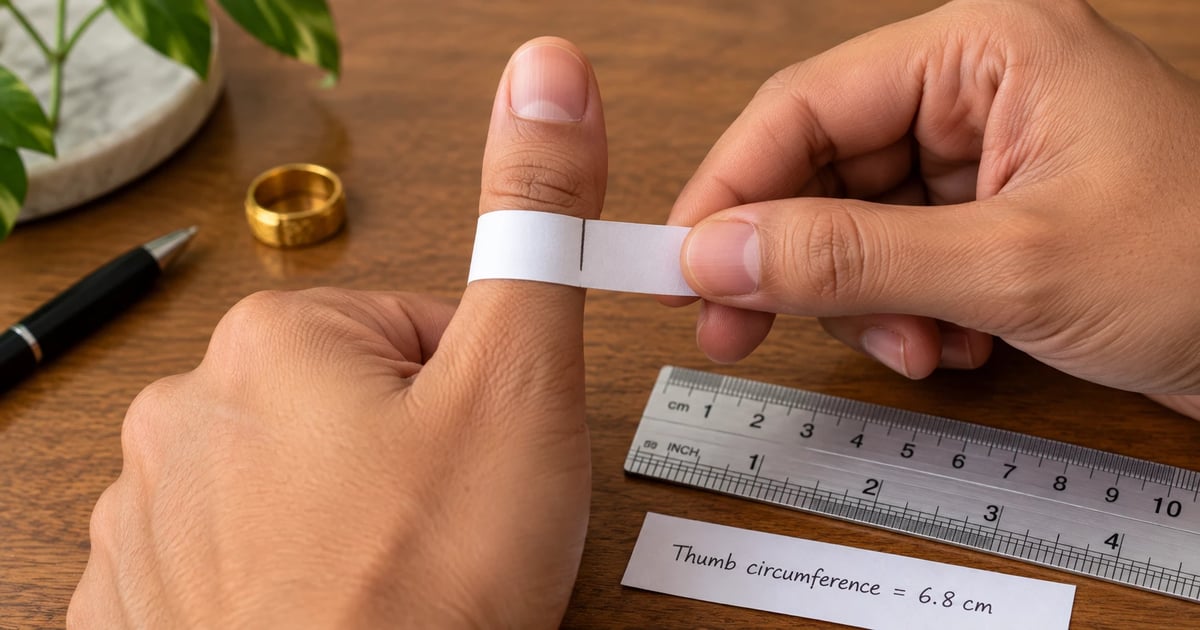
Take a strip of paper that is approximately 5 mm wide (you could use thread or dental floss).
Put it around the base of your thumb, making sure it is snug but not tight.
Find the point of overlap and put it flat against a ruler.
Your thumb circumference is in millimetres.
Divide by 3.14 to find the inner diameter in mm.
Convert them, since Indian ring sizes range from 1 to 30 and refer to the inner diameter; US size 9 is approximately 18.9mm, US size 10 is about 19.8mm and US size 11 is around 20.7mm. Indian size 20 is equivalent to about US 9.5 and Indian size 24 is equivalent to about US 11. In the case of UK sizes, letters are used with sizes S, T and U falling in the same range.
Before you make your decision carry out two checks. The first is to take the measurement in the evening since the fingers swell up during the day. The second is that the ring should fit your knuckle with a slight resistance rather than sliding over it.
Stop and Check for your beloved : Light Weight Tops Collections
Why your thumb ring keeps spinning
It's because the ring is slightly too big; your thumb tapers more acutely from the knuckle to its base than any of the other fingers, which is why a ring designed to slide over the knuckle ends up being loose underneath it.
The three options, listed in order of how well they hold. A jeweller can fit small sizing beads into the band (the most satisfactory solution). A wider band spins less than a narrow one since there is more surface area to grip. Half-sizing down is only possible if the ring still clears your knuckle.
A ring coming off is a different matter; in that case it needs resizing, not a workaround.
How wide the band should be
Start with 4mm and work from there.
Bands narrower than 3mm can appear as an afterthought on a thumb. Bands wider than 7mm begin to restrict the movement of the joint, a change you'll notice within a day.
Hand size affects the range but not the reasoning. Small hands tend to look better with band widths in the range of 3mm to 5mm. Larger hands are comfortable with 5mm to 8mm band width.
Be sure to examine the inner edge of the fitting surface first.A rounded inner edge of a 6mm band will be more comfortable than a flat inner edge of a 4mm band.
Cute and Stylist Baby Anklet that you won't miss !
22K or 18K for a thumb ring – that’s a choice, not a guess.
If you want the deep yellow color and you plan to keep the ring for resale go with 22K. It’s 916 fineness meaning 91.6% gold.. It’s softer. On a thumb, which grips and presses throughout the day a 22K ring gets dents. Loses its sharp edges faster than 18K.
18K is 750 fineness – 75% gold, more durable. It holds up better under stress. That’s not a compromise. It’s a decision based on how the finger behaves.
The market is shifting that way too. The World Gold Council says gold prices rose 60% year-on-year and that’s pushing people toward lighter lower-carat jewelry. India remains the market at 27% of global demand in Q2 2026.
So 18K on a thumb isn’t a step down. It’s a move matching the ring’s function to its environment.
Both. White gold come in 18K. White gold needs rhodium plating, which wears off every year or two. On a thumb? That plating wears out fast. You’ll need to replate often than, with other fingers.
Think about how the ring will be used not how it looks.
What you'll actually pay
Four components count towards the bill, and only one of them is the gold.
Gold value. Grams of gold multiplied by live rate (for that purity) for that day. Rates fluctuate daily against the IBJA benchmark, so refer to the live Kolkata gold rate rather than any quoted rate in an article.
Making charges. Either a flat rupee amount per gram of gold or a percentage of the value of the gold. Ask which one you're being charged, as on smaller pieces the difference can be significant. A 2-gram ring with percentage-based making charges often costs less than one with a per gram rate.
Wastage. Value of metal lost in fabrication, expressed as a percentage. Sometimes incorporated into making charges, ask for it to be broken out separately.
GST at 3%, applied on the total.
Run your quote through our gold jewellery bill calculator before you pay. The surprise is often how making charges dominate on a light ring (labour on a 2-gram band isn't that much less than on a 5-gram one).
One warning: if a quote seems unrealistically low for the weight and purity stated, the likely reason is that the piece is lighter or of a lower alloy than claimed.
Hallmark checks to run before you pay
Since the HUID was introduced, a hallmark on gold jewellery has three parts, not four. The Bureau of Indian Standards confirms the hallmark consists of the BIS logo, the purity in caratage and fineness and a six-digit alphanumeric HUID number unique to that item.
Any page still describing a four-mark system is out of date.
What to do at the counter:
Ask to see the marks under a magnifier. BIS requires jewellers to keep one of at 10x for exactly this.
Check that the fineness matches the carat claimed. 22K reads 916 18K reads 750.
Type the HUID into the BIS Care app. Use Verify HUID. It should return the items details.
Take an invoice showing weight, purity and charges.
On a ring this the marks are tiny and easy to skip. Don't. Our guides on checking purity before buying and what hallmark gold and BIS gold actually mean go through the same checks, in more detail.
How to wear and stack a thumb ring
It's mostly worn on a non-dominant hand to avoid collisions with a pen, phone and door knobs.
When stacking, leave the ring finger next to it empty, as two adjacent rings on a thumb and an index crowd the hand and click against each other when gripping. To balance the width of a thumb band, pair with thin rings on other fingers or vice versa; or go with a bolder ring on the middle finger. The whole hand looks flatter if all the rings are similar in width.
It's fine to mix metals, but not a good idea to mix purities on the same finger, as 18K and 22K rings will wear at different rates when they rub together.
As a gift, a thumb ring is more versatile than most rings, since it has no connotations of marriage or engagement, and a plain 2-3 gram band is appropriate for most men. The only thing that can go wrong is the size. An adjustable shank would solve that.
Men can wear one everyday without thinking about it, with the caveat of avoiding the gym and other activities where rings are a hazard. They can also be worn while working with tools, something not possible with most rings.