


Diamond Buying Guide 2026: Easy 4Cs & Certificate Checks
 Sujoy Dhar
12 min read
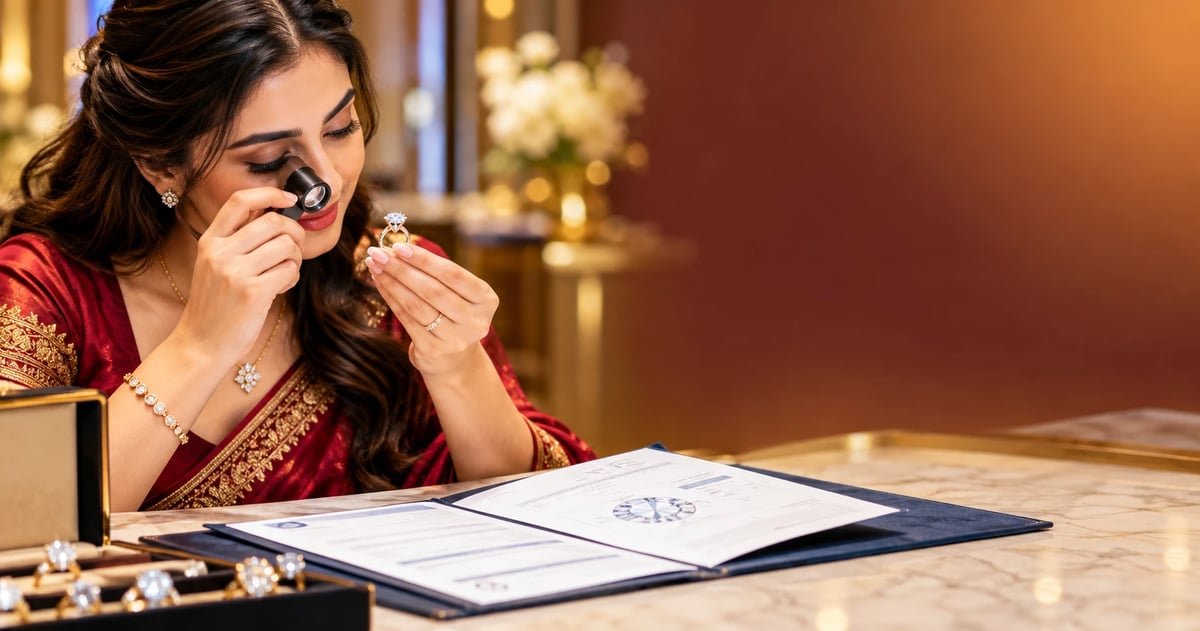
Key takeaways
Buying diamond jewellery in India comes down to three checks. First, “diamond” alone must mean a natural stone, and a laboratory-grown stone must be named in full. Next, the report number must match the lab’s online record. Finally, your bill must list stone count, total diamond weight, colour and clarity. For daily wear, GH-VS usually gives the best value.
Before you pay for diamond jewellery, check three things: the tag wording, the certificate number and the bill. This diamond buying guide shows first-time buyers in India how to run all three checks in about five minutes.
Under the BIS standard IS 19469:2025, the word “diamond” on its own means a natural diamond. A laboratory-grown diamond must be named in full. The 4Cs (cut, colour, clarity and carat weight) still decide the price. Once tiny stones sit in gold, a slightly lower grade usually looks identical and costs less.
What Are the 4Cs of a Diamond?
The 4Cs are cut, colour, clarity and carat weight, a grading system created by GIA (Gemological Institute of America). Cut matters most for a single stone, because it decides how much the diamond sparkles. On studded jewellery, the bigger question is whether dozens of tiny stones match each other.
Cut: The Grade That Controls Sparkle
Cut grade tells you how well a diamond’s angles bounce light back to your eye. GIA grades round diamonds as Excellent, Very Good, Good, Fair or Poor. A poorly cut stone looks dark in the centre, even with a top colour grade.
For a single round diamond, stick to Excellent or Very Good. Your report will also list polish and symmetry. These describe the surface finish and how evenly the facets (flat faces) line up.
Watch out for one trap. “Diamond-cut” on a gold chain or bangle means a shiny pattern cut into the gold. There’s no diamond in it.
Colour: How White the Diamond Looks
Colour is graded from D (colourless) to Z (light yellow or brown). D, E and F count as colourless. G to J are near-colourless, and their warmth usually shows only beside a whiter stone.
Your metal changes what you see. Yellow gold reflects warmth into the stone, so an H can look nearly as white as an F. White gold does the opposite and shows any tint more clearly.
Skip D colour for a nose pin. At that size you’ll never see the difference, but you’ll still pay for it.
Clarity: Inclusions, Blemishes and Eye-Clean Stones
Clarity grades the inclusions (marks inside) and blemishes (marks on the surface) that a grader sees at 10x magnification. GIA’s clarity scale has 11 grades. It starts at FL (Flawless), then runs through IF, VVS1, VVS2, VS1, VS2, SI1, SI2, I1, I2 and I3.
What you actually want is an eye-clean stone. That means no mark you can see without magnification at a normal viewing distance.
Is VS clarity good enough for a diamond ring? Yes. GIA describes VS inclusions as minor, ranging from difficult to somewhat easy to see at 10x. Clarity also rarely affects strength. The exception is a large feather, a crack-like inclusion, close to the girdle (the stone’s outer rim).
Carat Weight: Why 1 Carat Equals 0.2 Grams
One carat weighs 0.2 grams, and each carat splits into 100 points. So a 0.10 ct stone in a nose pin is 10 points, or 0.02 grams.
Carat measures weight, not size. A deep, poorly cut 0.60 ct stone can look smaller from the top than a well-cut 0.50 ct. Prices also jump at popular weights like 0.50 ct and 1.00 ct. That’s why a 0.45 ct stone often looks almost the same size for noticeably less.
Diamond Quality Chart: Which Colour and Clarity to Buy
For most buyers, GH colour with VS clarity gives the best value, paired with an Excellent or Very Good cut. Use this diamond quality chart to decode a tag before anyone explains it to you.
Tag reads | Colour means | Clarity means | Good fit for |
|---|---|---|---|
EF-VVS | E or F, colourless | VVS1 to VVS2, very hard to see at 10x | White gold, or when the top grade matters to you |
GH-VS | G or H, near-colourless | VS1 to VS2, minor marks at 10x | Rings, ear tops and pendants for daily wear |
GH-SI or HI-SI | Near-colourless | SI1 to SI2, easy to see at 10x | Budget pieces with very small stones |
IJ-SI or lower | Slight warmth possible | SI or I, larger marks may show to the eye | Yellow gold pieces where price matters most |
Best Grades for a Single Diamond Ring or Solitaire
For a single natural diamond of 0.30 ct or more, buy GH colour and VS1 or VS2 clarity. Pair it with an Excellent or Very Good cut. Put any savings into cut, not into D colour or VVS clarity.
There’s one honest exception: white gold or platinum. White metal shows tint, so F or G is worth the extra there.
Then check the stone yourself under the shop’s 10x loupe, a small jeweller’s magnifier, and in daylight.
Keep these grades in mind as you browse a diamond ladies’ ring or a diamond gents’ ring. For men’s styles and settings, our diamond ring for men designs and prices guide goes further.
What EF-VVS and GH-VS Mean on Studded Jewellery
On studded jewellery, “EF-VVS” means every stone falls within E to F colour and VVS1 to VVS2 clarity. Tiny stones are sorted into grade ranges, so the tag shows a range instead of one grade.
For example, a pendant tag might read: EF-VVS, 44 diamonds, total diamond weight 0.23 ct. That works out to about half a point per stone, or roughly 0.001 grams each.
At that size, few people can tell EF-VVS from GH-VS without a loupe. So GH-VS, or even GH-SI, suits daily-wear diamond earrings, a diamond nose pin or a diamond noa. Pay for EF-VVS only when the price gap is small or the setting is white gold.
What about the best diamond quality for daily wear jewellery? Honestly, the setting matters more than the grade. A bezel (a metal rim around the stone) or tightly closed prongs keep small stones in place.
Our diamond earrings designs and buying tips compares setting styles for tops. For nose pins, the diamond nose ring designs and prices guide covers backs and fittings. It also helps to know why tiny nose pins cost more per gram before you compare quotes.
The same logic applies to a diamond locket or a diamond ladies’ wristlet.
Natural or Laboratory-Grown: What the Tag Must Say
Under BIS standard IS 19469:2025, the word “diamond” on its own may only describe a natural diamond. A laboratory-grown diamond must be labelled “laboratory-grown diamond” or “laboratory-created diamond” in full. Short forms aren’t permitted, according to the GJEPC release on the IS 19469:2025 diamond standard. That rules out “lab grown”, “lab created”, “lab diamond” and “LGD”. “Fake” and “artificial” are not allowed either.
Use this test on any tag or bill:
“Diamond” with no qualifier means the seller is describing a natural stone.
“Laboratory-grown diamond” or “laboratory-created diamond” means the stone was grown in a laboratory.
An abbreviation, a brand name alone, or just “CVD” or “HPHT” means you should ask for the full term.
CVD and HPHT are the two main methods used to grow diamonds. They tell you how a stone was made, not whether it’s natural.
You can’t tell natural from laboratory-grown by eye or with a loupe. Only a gem lab can confirm a stone’s origin. That’s why the wording on your bill carries so much weight.
Check our Engagement Wedding Ring Collections !
How to Check a Diamond Certificate Before You Pay
A diamond certificate is genuine when its report number, grades and laser inscription all match the lab’s own online record. Labs call it a grading report, and shops call it a certificate. Same paper. Of every step in this diamond buying guide, this one protects your money most.
GIA vs IGI: Which Report Should You Trust?
Both GIA and IGI (International Gemological Institute) are independent labs, and you can check either report online. GIA is a nonprofit founded in 1931. According to GIA, it created the 4Cs and, in 1953, the grading system now treated worldwide as the standard.
IGI grades natural diamonds, laboratory-grown diamonds and finished jewellery. So is IGI certification good for natural diamonds? Yes, IGI issues full natural diamond reports.
Here’s our blunt view. For a single natural diamond costing several lakhs, ask for a GIA report. For studded jewellery, an IGI jewellery report is practical, because it covers the whole finished piece.
Watch the wording, too. GIA grades diamonds but doesn’t “certify” them. A store’s own certificate of authenticity is not a lab report.
How to Read a Diamond Grading Report
A diamond grading report lists the report number, date, shape, measurements, carat weight, colour and clarity. Round natural diamonds also get a cut grade. Below that, you’ll find polish, symmetry and fluorescence, a glow some stones give off under UV light. Many reports also show a plot, a small map of the inclusions.
Read the title line first. It tells you whether the report covers a natural diamond or a laboratory-grown diamond.
Match the Report Number, Inscription and Online Record
A report can be genuine yet belong to a different stone. These five steps tie the paper to the diamond in your hand:
Find the report number, usually printed near the top.
Enter it on GIA Report Check, or on IGI’s website under Verify Your Report.
Compare every field, including carat weight to two decimals, colour, clarity and measurements.
Ask to see the laser inscription under the shop’s loupe or microscope.
Confirm the inscribed number matches the report exactly.
A laser inscription is a tiny number etched on the girdle. You can’t see it without magnification. Not every diamond has one, so ask before you assume.
If any detail differs, don’t pay until the jeweller explains it in writing.
How you can determine the Gold Reslae Value ?
Certificate Checks for Pieces With Many Small Diamonds
Small accent diamonds rarely get individual certificates, so you check the piece as a whole. Jewellers call these tiny stones melee. A ring with 18 melee stones won’t come with 18 reports.
Instead, the piece-level certificate should list four details that your bill repeats:
Stone count
Total diamond weight (TDW), the combined weight of every stone
Colour range, such as GH
Clarity range, such as VS
Match all four between the certificate and the bill, digit for digit. Count the stones yourself if the design allows it. Then keep both papers together, because you’ll need them at exchange time. Some jewellers deduct a fixed sum for each missing solitaire certificate.
What a 2026 GIA Laboratory-Grown Report Shows
Since 1 October 2025, GIA no longer gives laboratory-grown diamonds D-to-Z colour or clarity grades. Instead, the GIA Laboratory-Grown Diamond Quality Assessment labels each stone Premium or Standard.
Premium needs D colour, VVS clarity or higher, and Excellent polish and symmetry. Standard covers E to J colour with at least VS clarity. Any stone below Standard gets no GIA assessment at all. On top of that, GIA only accepts laboratory-grown stones of 0.15 ct and above. Each one is laser-inscribed with “Laboratory-Grown” and its assessment number.
Natural diamonds still receive full 4Cs grades from GIA. Older GIA laboratory-grown reports, issued before October 2025, may still show letter grades. Other labs, including IGI, still print colour and clarity grades on laboratory-grown reports.
So a 2026 GIA laboratory-grown report without a colour grade isn’t faulty. It simply follows GIA’s new format.
You might love to read the Gold vs Platinum Article !
What Should a Diamond Jewellery Bill Show?
Your bill should describe the gold and the diamonds separately, so each part can be valued later. Check for these lines before you pay:
The stone named as “diamond” or “laboratory-grown diamond”, in full
Gold purity, such as 18K, with the BIS hallmark and HUID (a six-character ID)
Gross weight, net gold weight and total diamond weight in carats
Stone count, colour range and clarity range
Lab name and report number, if a report comes with the piece
Gold value, diamond value, making charges and GST as separate amounts
Exchange and buyback terms, printed or attached
Diamond jewellery is usually set in 18K gold, because it’s harder than 22K and grips stones better. The gold part follows the same rules as plain gold jewellery. Our gold purity checklist explains how to read the hallmark. If the labels confuse you, hallmark gold vs BIS gold clears them up. To check the gold value on your bill, try our gold calculator for jewellery bills.
Diamond Exchange and Buyback: Questions to Ask
Diamond jewellery does have resale value in India, but expect to get back less than you paid. Buy it to wear, not to save.
Unlike gold, diamonds have no daily published rate. Instead, each jeweller sets its own exchange and buyback terms for diamonds. Ask these questions before you pay, and get the answers in writing:
What rate applies to the diamonds at exchange, and at cash buyback?
Do the terms differ for natural and laboratory-grown diamonds?
Which papers must you bring, and what happens if one is lost?
Does the policy apply at every branch?
You can read Biswakarma’s current refund and exchange rules before you visit.
Diamond Buying Guide Checklist Before You Pay
This checklist takes about five minutes at the counter. Print it, or save a screenshot on your phone.
The tag says “diamond” or “laboratory-grown diamond” in full.
Colour and clarity grades, or ranges, are written on the tag.
For a single stone, the cut is Excellent or Very Good.
You’ve seen the stone under a 10x loupe and in daylight.
The report number checks out on GIA Report Check or igi.org.
The laser inscription matches the report, where there is one.
Stone count and total diamond weight match on the certificate and the bill.
The gold carries a BIS hallmark with HUID.
Gold value, diamond value, making charges and GST appear separately.
Exchange and buyback terms are in writing.
Take this diamond buying guide checklist into the shop. A good jeweller will answer every line without rushing you. Planning gold pieces for a wedding as well? Our bridal jewellery guide covers that side.