

Eye-Catching Gold Mens Bracelet Designs for 2026
 Sujoy Dhar
10 min read
Sujoy Dhar
10 min read
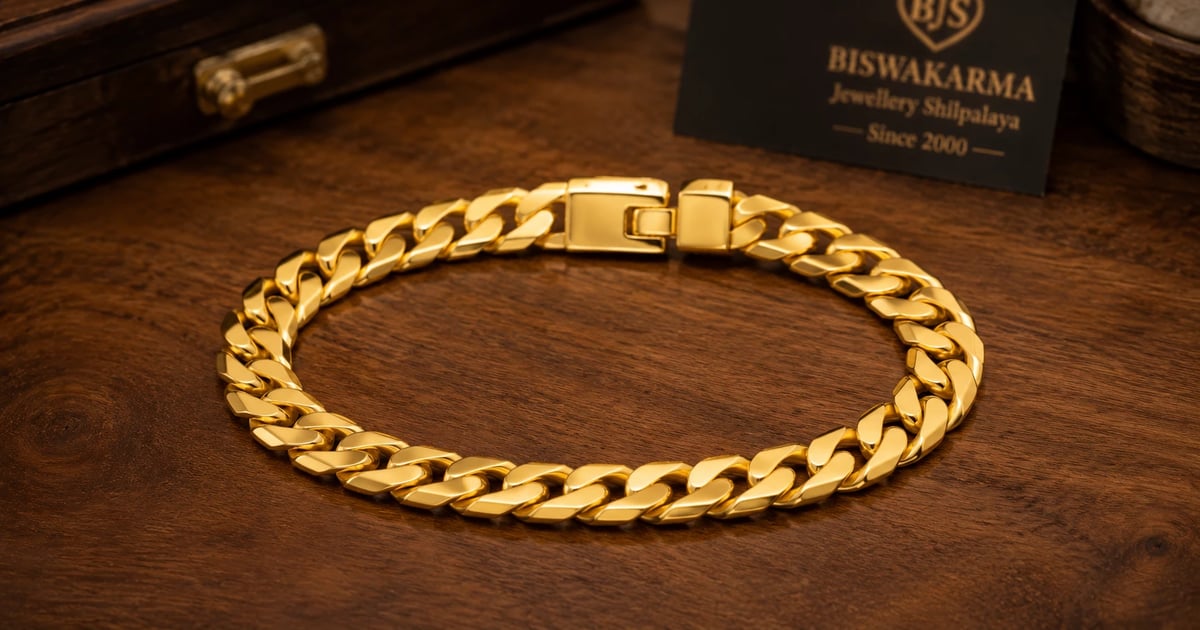
Most men buying a gold mens bracelet want one number first. How many grams? For 2026, the sensible band runs 8 to 15 grams for daily wear. That is lighter than the 20 to 30 gram pieces many shops still show you first.
The shift isn't a downgrade. It's a response to price.
Want a rigid band instead? That is a different purchase, and our gents kada designs guide covers it. This page stays with link and chain bracelets.
The short answer: grams, purity and one design
A gold men's bracelet in 2026 usually sits between 8 and 15 grams. Choose 18K for a daily-wear link bracelet, because it resists joint wear better than 22K. Pick 22K for occasion wear and stronger exchange value. Insist on a box clasp with a safety latch above 10 grams.
Trending gold mens bracelet designs, sorted by grams
Weight moves with length, width and construction. So treat every band below as typical, not as a fixed spec.
Price is reshaping this category faster than fashion is. The World Gold Council's Q2 2026 India report puts Indian jewellery demand at 75 tonnes, down 15% year on year. High prices, it says, are pushing buyers towards lighter and lower-carat pieces.
Light band: roughly 4 to 8 grams
Flat curb link. The flattest profile you can buy, and it slides under a cuff without catching. Making charges stay modest, because the links are simple to finish.
Box link. Square links that hold their line rather than draping. More soldered joints mean more labour, so making charges climb even at low weight.
Slim Figaro. Alternating long and short links. The rhythm adds visual width without adding grams, which suits a narrow wrist.
Dokia-style link. A Bengali workshop staple. Our dokia chain design guide explains how the link goes together.
Verdict: best for a first piece, or anyone worried about looking loud.
Mid band: roughly 8 to 15 grams
Cuban link, narrow to medium. Interlocking flattened links, the most requested pattern right now. Metal volume drives the price; polishing time drives the making charge.
Rope link. Twisted strands that catch light from every angle. Labour-heavy, so expect the highest making charge per gram here.
ID or plate bracelet. A flat plate on a link chain, ready for engraving. The plate holds most of the weight, and engraving bills separately.
Textured or diamond-cut link. Machine-cut facets across each face. Texture hides daily scuffs far better than a mirror polish.
Verdict: the daily-wear sweet spot for most adult wrists.
Heavy band: 15 grams and up
Broad Cuban link. The piece that looks substantial in photographs. It also carries the highest hollow-construction risk here.
Heavy curb with a bevelled face. Wide, flat and unmistakably formal. Keep it for weddings rather than a working week.
Honest verdict: at today's rates, this is a wedding and gifting band.
👀 Did you Missed Gents Kada Designs?
How many grams your bracelet should be
Match the weight to your wrist, not to your budget ceiling.
A wrist under 16cm carries 6 to 10 grams comfortably. Between 16 and 18cm, 10 to 15 grams sits well. Above 18cm, you can pass 15 grams without looking oversized.
Those are proportions, not rules. Try the piece on first.
One caution. A bracelet too wide for your wrist is what reads as trying too hard. Weight rarely causes that impression. Proportion does.
22K, 18K or 14K for a flexible link bracelet
Here is the distinction almost nobody explains. A rigid kada dents. A flexible bracelet wears at its joints and fails at its clasp. That changes the purity answer completely.
In a link bracelet, every link rubs its neighbours all day. 22K gold is 91.6% pure and correspondingly soft. Over years of daily wear, those contact points thin, links elongate, and the bracelet starts to stretch.
18K gold is 75% pure, and the extra alloy makes it harder. It holds joint tolerances longer in a flexible piece. That is why an 18K gold bracelet for men often outlasts a 22K one at the same weight. Our guide to checking gold purity shows how to confirm it.
14K is harder still. But the colour reads paler, and Indian exchange demand for it is thinner.
Purity | Fineness | Best use in a link bracelet | Trade-off |
|---|---|---|---|
22K | 916 | Occasion wear, gifting, exchange value | Softest; joints wear and links stretch |
18K | 750 | Genuine daily wear | Paler colour; lower metal value per gram |
14K | 585 | Rough daily use, gym, travel | Palest; weaker resale demand in India |
So is a 22K gold bracelet for men good for daily wear? Yes, if the links are chunky and you remove it for sport. For a slim link worn daily, 18K is the better engineering choice.
The counterpoint is real. 22K returns more metal value per gram at exchange. If that matters more than longevity, buy 22K and accept the wear.
Hollow or solid, and how to tell at the counter
A hollow bracelet is built from tube, not solid rod. It can look like 30 grams and bill like 12.
Hollow construction is not fraud. It is a legitimate way to get visual width affordably. The problem is buying hollow while believing you bought solid. Any lightweight gold bracelet for men deserves this question.
Four checks, no equipment needed:
Ask directly, then ask for it in writing. The word "hollow" or "solid" should appear on your invoice.
Compare grams against size. Hold it beside a solid piece of similar length. Bigger for fewer grams means hollow.
Feel the heft. A hollow piece feels wrong-light for its bulk once it's in your palm.
Look at the end links. Where the chain meets the clasp, tube walls are sometimes visible at the cut.
Now the part that matters later. A dented hollow link rarely repairs cleanly, because a crushed tube will not push back into shape. Solid links can be reworked. Hollow ones usually get replaced.
The clasp decides whether you keep it
A gold men's bracelet fails at the clasp far more often than at the links. Almost nobody mentions this.
A plain lobster clasp is a spring-loaded gate with one failure point. On a light bracelet, fine. Above 10 grams, we won't fit one for a bracelet meant for daily wear.
The reason is mechanical. A lobster gate opens under twist. Catch it on a bag strap or a metro handrail, and it rotates open by itself.
A box clasp works differently. A shaped tongue snaps into a box and holds under tension rather than spring pressure. Add a safety latch, which is an independent second catch, and two separate things must fail before the bracelet drops.
Test it at the counter. Close it, pull gently in line, then twist. A clasp that pops under a twist will pop on the street.
Also check the joint where the clasp meets the chain. That solder point takes every load, so stretch shows there first.
Measuring your wrist for the right length
Do this before you shop, not at the counter.
Wrap a strip of paper snugly around your wrist, just below the wrist bone.
Mark the overlap, then measure the strip against a ruler in centimetres.
Add 1.5 to 2cm for comfortable drape on a link bracelet.
Convert if the shop quotes inches. One inch is 2.54cm.
Check the fit: it should slide a centimetre along your wrist, never over your hand.
Width changes the maths. A broad Cuban link needs more length than a slim curb. It sits higher off the skin.
One thing to settle before payment. If links are removed to shorten the piece, the gram weight drops. Ask for the final weight after adjustment, and make sure the bill reflects it.
What pushes up the price on your bill
Three components, all of which belong on separate lines.
Metal. Gram weight times that day's rate for that purity. Ask which rate applied, and on which date. Our gold calculator for jewellery bills checks the arithmetic against the Kolkata gold rate.
Making charges. These cover craftsmanship, and they swing hard by pattern. A rope link carries far higher charges than a plain curb of identical weight. Some shops quote a percentage, others a rate per gram. Ask which, then ask the rupee figure.
Tax. Ask for it as its own line rather than folded into a total.
Budget-first shoppers can run this backwards. Take your ceiling, say ₹50,000, and divide by the current per-gram rate for your purity. Subtract making charges and tax, and you have your realistic gram band.
Wastage charges deserve a direct question too. Where they still appear, ask whether they sit inside the making charge or on top of it.
For scale, the World Gold Council put Q2 2026's average domestic spot price at ₹1,50,733 per 10 grams. That benchmark is for fine gold, so your 22K rate sits lower. Rates move daily, so any quote is good for that day only.
Hallmark and HUID checks before you pay
Three marks, two minutes.
Every hallmarked gold article carries the BIS logo, the purity in carat and fineness, and a six-digit HUID. That stands for Hallmark Unique Identification. Check it yourself in the BIS Care app, using Verify HUID.
Two details most buyers never hear.
First, mandatory hallmarking covers six caratages: 14K, 18K, 20K, 22K, 23K and 24K. Despite what several 2026 blogs claim, 9K gold remains a voluntary grade under IS 1417:2016, not a mandatory one.
Second, coverage is district-by-district rather than national. The framework reached 392 districts on 3 August 2026, out of roughly 800 in the country. Check whether yours is covered before assuming the shop is obliged.
One gap is worth knowing. BIS exempts articles under two grams from mandatory hallmarking, so very light charms and spacers may arrive unmarked.
Your bill has legal requirements of its own. BIS rules require four things on it. Description, net precious-metal weight, purity in carat and fineness, and hallmarking charges. If a shop won't itemise that, you have your answer. Our guide to hallmark gold vs BIS gold covers what the mark does and doesn't promise.
What comes back when you exchange it later
This is the question first-time buyers rarely ask aloud.
Exchange is now mainstream, not a fallback. The World Gold Council reported exchange volumes rising 10% to 20% in Q2 2026. At some shops, exchange reached 70% of sales.
The mechanics are plain. Metal weight and purity get valued. Making charges do not come back, and neither does tax you already paid.
So the hollow question matters here too. A hollow bracelet exchanges on its grams, not on how large it looks.
Keep the original bill showing gram weight and purity. Terms vary by jeweller and by date, so confirm them at the counter.
Wearing it with a watch, a kurta or a shirt cuff
Opposite wrist to your watch is the safe default. Metal on metal scratches both, and the watch crown is the usual culprit.
Sharing one wrist? Keep the bracelet slim, and let it sit above the watch rather than below it.
Under a formal shirt, width matters more than weight. Much past 10mm and the piece fights the cuff edge.
Kurtas are more forgiving. The sleeve is looser, so a mid-band textured piece works without bunching.
One piece per wrist, sized properly, in a finish that isn't mirror-bright. That has never looked like effort.
Buying your first one without overthinking it
Start in the 8 to 15 gram band, in a plain or lightly textured link.
Choose 18K if it will be on your wrist every day. Choose 22K for occasions, and for the better exchange rate per gram.
Then spend two minutes on the clasp and the hallmark. Those checks protect more money than the design choice ever will.
You can add a heavier piece later. Buying heavy first, then leaving it in the locker, is the expensive mistake.
Browse our gents bracelets and wristlets to see current weights and patterns.