


New Noya Designs 2026 : Best Styles, Weights & Prices

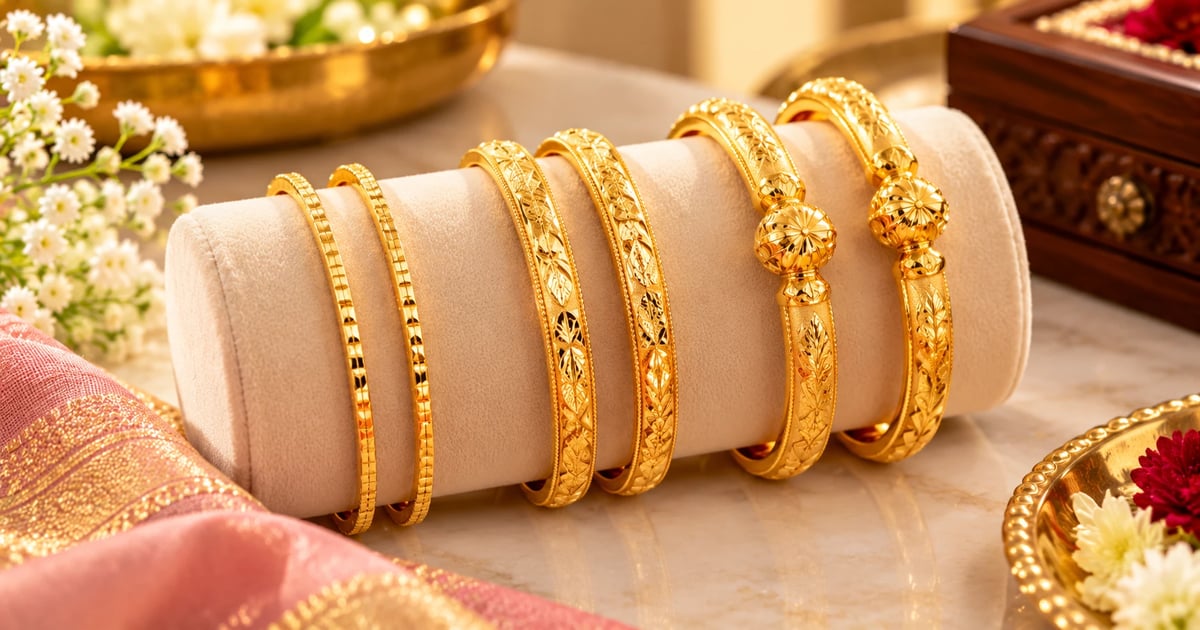
New noya designs in 2026 carry less gold and more pattern than the noya your mother wore. The newest pieces in our catalogue hold 0.2 g to 1.3 g of 22K gold. Bridal mukh noa still run from about 3 g to 9 g and beyond.
Every weight and price below comes from biswakarmagold.com listings checked on 24 September 2026. Gold rates change daily, so treat each rupee figure as a snapshot. The weights and style differences won't change.
What Is a Noya (Noa) Bangle?
Noya and noa are the same bangle. The spelling shifts with whoever is saying it, and "nowa" turns up too.
Underneath sits a plain iron ring. A Bengali bride receives it at her wedding, traditionally from her mother-in-law. Hindu Blog's explainer on the noa custom places it on the left wrist. It also notes that in some parts of Bengal, the husband puts it on.
Gold came later. Jewellers bind 22K gold over the iron core, a build Bengalis call lohabadhano or noa badhano. The core keeps the ritual meaning. The gold turns a married woman's bangle into jewellery you actually want on show.
Many families believe the iron protects the marriage. That's a cultural belief, and it's worth respecting as one. For buying, the practical point is simpler. Most of your noya's weight is core, and you pay gold prices only on the gold.
Noya vs Shakha vs Pola: Where It Fits in the Bridal Set
A Bengali bride's wrist set has three separate pieces. Each is made from a different material, and each ages differently.
Noya (noa) | Shakha | Pola | |
|---|---|---|---|
Base material | Iron, sometimes steel | White conch shell | Red coral or lac |
How gold is added | Gold bound over the core | Gold caps or bands (shakha badhano) | Gold caps or bands (pola badhano) |
Weak point in daily wear | Rust where gold meets core | Can crack if knocked hard | Can chip or fade |
The noya is the only one of the three with a metal core. So it's the piece most likely to stay on your wrist for decades. Choosing gold work for your shakha too? Our guide to sakha badhano styles and weights covers that half of the set.
New Noya Designs to Know in 2026
On 24 September 2026, our latest noa bangle collection held 202 pieces, with 140 in stock. Five styles cover nearly all of them. Here they are, with the numbers a photo caption leaves out.
Every weight below is net gold weight. The bangle on your wrist weighs more, because the core adds bulk. In total, most pieces weigh roughly 9 g to 23 g.
Soru Peti Noya: Slim and New This September
Four soru peti noa landed on 11 September 2026. Each holds between 0.57 g and 0.65 g of 22K gold. Their listed prices run from ₹10,979 to ₹12,179.
Soru means slim. The band is narrow and rounded, so it slides under a kurti cuff or a shirt sleeve. Dot cuts, facet lines, cross cuts and a two-tone finish catch the light without adding weight.
Want one lightweight noya design for daily wear? Start here.
Featherweight Path Noya Under ₹6,500
Path means flat. These July 2026 pieces carry just 0.18 g to 0.24 g of gold. They list between ₹5,450 and ₹6,349, the lowest entry price in the range.
You get the look and the ritual core for very little gold. The trade-off is a thin gold layer. On a bangle you never take off, thin gold shows wear sooner than thick gold.
A few other light soru and path pieces are 14K rather than 22K. Check the purity mark if 22K matters to your family.
Engraved Path Noya Around 1.2 g
Two engraved path noa arrived in August and September 2026. Each holds about 1.23 g to 1.25 g of gold, listed near ₹22,200 to ₹22,600.
Why pay nearly four times the featherweight price? More gold means a thicker cover that can take engraving. The floral and leaf lines are cut into the metal, so they stay crisp longer than a surface pattern.
This is our pick for a daily noya that still looks worked up close.
Mukh Noa: The Bridal Statement Piece
Mukh (also spelt muk) means face. The front of the band widens into a worked motif, while the back stays plain. That's how a mukh noa design looks rich at the front without full-band weight.
It's our biggest group, with 63 pieces in stock. Net gold runs from 2.63 g to 13.6 g, and prices from ₹47,618 to ₹2,45,242. The middle of the range sits near 5.5 g of gold and about ₹1,00,000.
The newest series arrived in May 2026. It brings swan, peacock, geometric and orbit motifs at 3.07 g to 3.8 g of gold. Those list between ₹54,616 and ₹67,534.
For a bride on a moderate budget, that 3 g to 4 g band is the sweet spot. You get a true mukh front at roughly half the typical mukh price. It's our pick for a noya bangle for a bride.
Planning a heavier statement piece for the bridal trousseau? Look at the 6 g to 9 g end instead.
Half Round Noya for All-Day Comfort
Half round describes the band's cross-section. The outer face is domed and the inner face lies flat against your skin.
Only four are in stock, holding 3.44 g to 6.4 g of gold. Prices run from ₹62,401 to ₹1,13,750. They cost more than a slim soru, but a flat inner face presses less on the wrist bone. If you sleep in your noya, that matters.
We also list five diamond noa in 18K gold, starting at ₹1,23,848. They're a separate purchase decision, because stone value adds to the bill.
Baki and Bani Noa: Older Names You'll Still Hear
Your mother or aunt may ask for a baki noa, with a zigzag or wave pattern. Others ask for a bani noa, which has a braided look. Those names describe the pattern, not the build.
Today, many workshops file them under path or mukh. So carry a photo to the shop rather than relying on the name alone.
How Much Gold Is Actually in a Noya Bangle?
A gold noya bangle holds far less gold than it weighs. In Biswakarma's 2026 range, net 22K gold runs from about 0.2 g to 13.6 g. Slim path noya sit at the low end and heavy mukh noa at the top. An iron or steel core makes up the rest, bringing most pieces to 9 g to 23 g.
So when a shop quotes a gold noa bangle weight, ask whether it's gross or net. The gap explains three things buyers often find confusing.
Your bill. You pay the gold rate on net gold only. The core appears as a small separate charge, between ₹250 and ₹580 on our listings.
How it feels. A 0.6 g soru noya still feels like a 10 g bangle on your wrist. Comfort depends on the core and profile, not the gold weight.
What you get back later. When an old noya is exchanged, only the gold carries value. The core has none, whatever it cost to make.
One more detail most shops don't volunteer. Most of our noya use an iron (loha) core, but about a third use steel. If your family's custom calls for iron, ask for a loha core. The listing names the core in that separate charge line.
Full Cover vs Half Cover Noya: Which to Choose
A full cover noya has gold wrapped around the whole core, inside and out. A half cover noya has gold on the outer face only, so the core touches your skin. We stock both.
Full cover | Half cover | |
|---|---|---|
Gold used | More | Less |
Price | Higher | Lower |
Core touches skin | No | Yes |
Rust risk | Lower | Higher, needs drying after washing |
Best for | Everyday wear through cooking and washing | Wedding and festivals, or a tight budget |
Neither is better value in every case. Full cover suits you if the noya never leaves your wrist. Half cover makes sense if it's mainly for occasions, or if you'd rather spend on a mukh front.
Not every product page names the cover type. So ask which one a piece has before you order. The net gold weight gives a quick clue: at the same size, more gold usually means more coverage.
Keep one distinction clear. Cover work is real 22K gold, sold and billed by weight. Gold-plated jewellery is different. Plating leaves a thin chemical coat with no net gold weight on the bill. If a "gold noya" costs a few hundred rupees, it's plated.
How Much Does a New Noya Design Cost?
On 24 September 2026, 22K noya on biswakarmagold.com listed from ₹5,450 to ₹2,45,242. The figure that decides your price is net gold weight. Here's how our in-stock 22K pieces fall by weight, diamond noa excluded.
Net gold weight | Pieces in stock | Listed price range | Main styles |
|---|---|---|---|
Under 2 g | 37 | ₹5,450 to ₹35,306 | Soru, path |
2 g to 4 g | 40 | ₹36,418 to ₹72,042 | Path, mukh, half round |
4 g to 6 g | 25 | ₹73,019 to ₹1,06,268 | Mostly mukh |
6 g to 10 g | 23 | ₹1,10,451 to ₹1,58,876 | Mukh |
10 g and above | 2 | ₹1,80,636 to ₹2,45,242 | Mukh |
These are retailer-listed prices, not independent quotes. They'll move with the gold rate. For live figures, check today's gold rate in Kolkata before you visit.
Noya Gold Price per Gram in 2026
Our 22K (916) rate stood at ₹14,560 per gram on 23 September 2026. The 14K (585) rate was ₹10,690.
Every listed noya price is built from four lines:
Net gold weight multiplied by the day's rate
Making charges, either a percentage (18% or 20%) or a flat fee
The core charge
GST at 3% on the total
Heavier pieces carry percentage making. The lightest ones carry a flat fee, between ₹1,780 and ₹3,380 on our listings. Our gold noa price guide runs the same maths across more weights.
Why the Lightest Noya Costs More per Gram
Take a featherweight path noya with 0.23 g of gold. The gold costs ₹3,349. Then add ₹2,280 flat making and a ₹390 core charge. With GST, the listed price is ₹6,199.
Gold is only about 54% of that bill. In effect, you pay close to ₹26,950 per gram of gold.
Now compare a 3.07 g mukh noa from the May series. It lists at ₹54,616, with 18% making. That works out to about ₹17,790 per gram, and gold is about 82% of the price.
Want a noya design with minimum making charge relative to its gold? The 3 g to 6 g range usually does better. Always ask for making charges as a separate line before you decide.
Hallmark and Bill Checks Before You Pay
A valid hallmark has three marks. The BIS hallmarking FAQ lists the BIS logo, the purity in carat and fineness, and a six-digit HUID. HUID stands for Hallmark Unique Identification. BIS has used this three-mark format since 1 July 2021. You can check any HUID in the BIS Care app.
Light pieces are a grey area elsewhere. The BIS guidance for jewellers exempts articles under two grams from mandatory hallmarking. So a light noya from another shop may legally carry no hallmark.
Every Biswakarma noya is BIS hallmarked with a HUID, including the lightest pieces. The same BIS guidance also says your bill must show the net weight of precious metal. Read that number, not the gross weight. For more on what the marks mean, see our explainer on hallmark gold vs BIS gold.
Choosing a Noya for Your Wedding and Daily Wear
Start with the years after the wedding, not the wedding day. Many women wear their noya daily for decades. A piece that looks grand in photos but catches on every sleeve won't stay on.
The best noya design for a Bengali bride in 2026? We'd pick a 3 g to 4 g mukh noa. The front reads as bridal, and the weight stays wearable afterwards.
For a lightweight noya design for daily wear, go soru peti or engraved path. Both sit under a sleeve and suit an office wrist.
Check the width against your shakha pola. A wide mukh front beside thick shakha and pola can crowd the wrist. Try all three together if you can.
Worried it will look dated? Plain path and slim soru profiles change least over the years. Heavily themed motifs follow trends more closely.
Buying for someone else? Borrow a bangle she already wears and measure its inside diameter in millimetres. A noya that spins loosely wears thin at one spot.
One honest caution. If your aim is gold you can melt and remake later, a cored noya is the wrong buy. Only the gold carries value, and on light pieces that's under a gram. A plain 22K bangle suits that plan better.
Ready to compare new noya designs side by side? Browse our full noa collection, sorted into soru, path, mukh, half round and diamond noa.
Caring for Your Gold Noya Bangle
Rust starts where gold meets core. So dry your noya properly after washing your hands, especially along the edges. Half cover pieces need this most, since the core is exposed on the inside.
Take it off for swimming and long cooking sessions. Chlorine and steam both work into the seam.
Sindoor, turmeric and oil build up in carved lines. Clean them with warm water and a soft toothbrush, then dry well.
Skip harsh polishing. Repeated heavy polishing wears down the gold cover, and thin covers have little to spare.
Spotted a brown line at the edge? Bring it in early. A small rust patch is easier to deal with before it spreads under the gold.