


Daily Wear Gold Bangles Design: Best Styles & Buying Guide
 Sujoy Dhar
9 min read
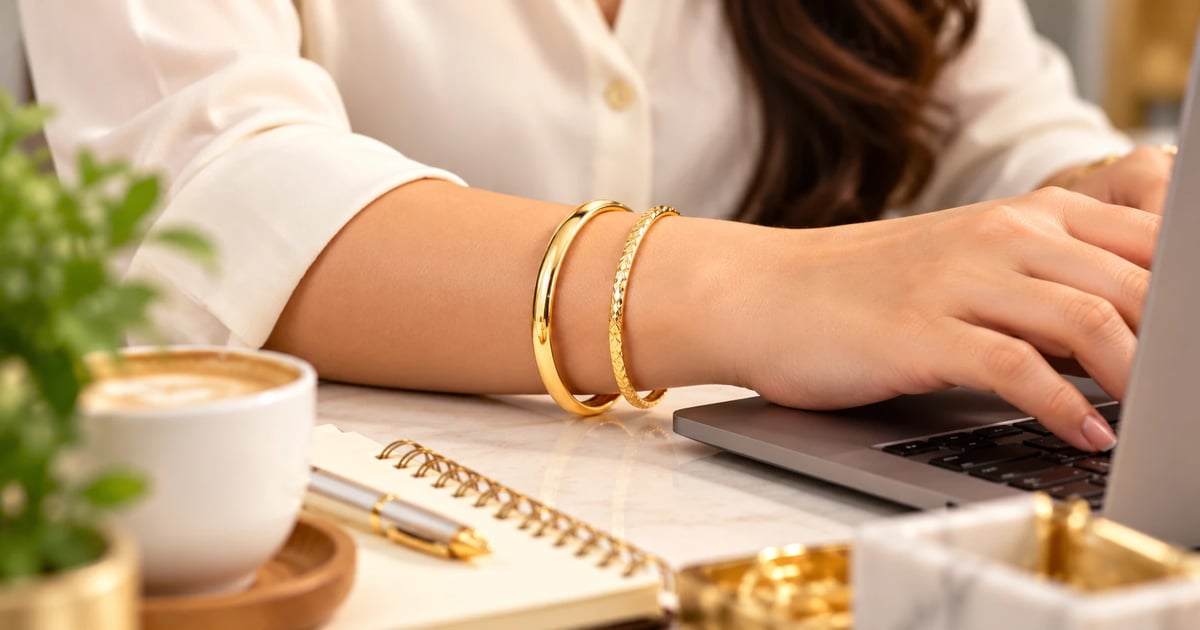
The best daily wear gold bangles design is simple, solid and BIS hallmarked, weighing about 6 to 12 grams. Choose 22K gold (91.6% pure) for plain, solid bangles. Choose 18K gold (75% pure) for thin, textured or diamond designs. The harder 18K alloy resists dents and scratches better in everyday use.
A lighter bangle isn't a compromise. It's the one you'll actually keep on, so it earns its price every day.
Get four checks right first: karat, weight, hallmark and price. Then match a design to what your hands do all day.
22K vs 18K Gold for Bangles You Wear Every Day
Karat tells you how much of the metal is pure gold. The rest is alloy, usually copper and silver, which adds hardness.
22 karat gold is marked 916, meaning 91.6% gold. It has the deep yellow colour most Indian families expect. But it is softer, so a thin 22K bangle can bend or scuff at a desk.
18 karat gold is marked 750, meaning 75% gold. The extra alloy makes it harder, so it holds sharp edges and stone settings better. The colour is a shade paler, which some buyers notice next to older 22K pieces.
Point | 22K (916) | 18K (750) |
|---|---|---|
Gold content | 91.6% | 75% |
Hardness | Softer, dents more easily | Harder, holds shape better |
Colour | Rich, deep yellow | Slightly lighter yellow |
Best for | Plain, solid, thicker bangles | Thin, textured, stone or diamond bangles |
Metal cost per gram | Higher | Lower |
Most 22K gold bangle designs for daily wear stay plain or lightly textured for this reason. If you want a plain bangle with a solid wall, 22K works well. If you want something slim or set with stones, 18K is the safer everyday choice.
How Many Grams a Daily Wear Gold Bangle Should Weigh
Weight decides comfort, durability and price all at once. Use these bands as a practical starting point, not a rule.
Weight per bangle | What it suits | Watch out for |
|---|---|---|
Under 6 g | Thin churis worn in a stack | Very thin walls can bend or dent |
6 to 12 g | One or two bangles worn solo every day | Very little; this is the everyday sweet spot |
12 g and above | Kadas and statement pieces | Heavier on the wrist at a keyboard |
A daily wear gold bangles design in 10 grams sits right in the middle band. It feels present without dragging on your wrist during a long workday.
Weight alone doesn't tell you strength. Ask whether the bangle is solid or hollow. A hollow bangle looks bigger for less gold. But one knock on a door frame can leave a dent that's hard to fix.
How to Check the BIS Hallmark Before You Pay
Hallmarking is the government's purity stamp on gold jewellery. BIS, the Bureau of Indian Standards, runs the scheme.
Many older buying guides still say hallmarking covers only 14, 18 and 22 karat. That's out of date. The BIS hallmarking FAQ lists six caratages that can be hallmarked: 14K, 18K, 20K, 22K, 23K and 24K.
Run these checks at the counter:
Find three marks on the bangle. BIS's FAQ for jewellers names the BIS logo, the purity mark (for example, 22K916) and a six-digit HUID code.
Verify the HUID. HUID means Hallmark Unique Identification. You can check it with the Verify HUID feature on the BIS CARE app, as BIS confirmed in March 2026.
Match the app result to the bill. The karat and article type on the app should agree with your invoice.
One edge case matters for light pieces. BIS exempts articles weighing less than two grams from mandatory hallmarking. Most daily wear bangles are heavier than that, so expect a full hallmark.
If you want a longer walk-through, read Hallmark Gold vs BIS Gold: The Real Difference. It also explains what to do if a HUID doesn't verify.
Still unsure after buying? An Assaying and Hallmarking Centre (AHC), a BIS-recognised testing lab, can retest purity for a fee.
What Sets the Price of an Everyday Gold Bangle
Four parts make up the final bill. First comes net gold weight multiplied by the day's gold rate per gram. Next are making charges, the jeweller's labour fee. Stones, if any, are priced separately. GST is added on top.
Here's how the metal value alone works out. On 23 September 2026, Biswakarma's Kolkata gold rate board showed 22K at ₹14,560 per gram. At that rate, an 8 g bangle carries ₹1,16,480 of gold before making charges and tax. The same 8 g in 18K, at ₹11,800 per gram, comes to ₹94,400.
Those figures move every day. That's why any daily wear gold bangles design catalogue with price goes stale almost at once. Treat listed prices as a guide and ask for the day's figure.
GST on gold jewellery is 3%, according to ClearTax's guide to GST on gold. Check how your bill applies it to making charges, since presentation differs between shops.
Making charges matter more on light bangles. Intricate cutting on a 6 g piece can cost nearly as much labour as on a 12 g one. As a result, the labour share of your bill rises as weight falls.
A quick test from the World Gold Council's My Gold Guide helps here. Divide the final price by the gold weight. Then compare that per-gram figure with the day's rate to see what you're paying above metal value. To run the full sum, use the Gold Calculator for Indian Jewellery Bills.
Churi, Kada and Bangle: What Each Name Means
"Bangle" is the umbrella word for any rigid ring worn on the wrist. The other names describe shape and thickness.
A churi is a thin, round bangle, often worn in sets of two or more. It's light and stacks easily, which makes it a classic choice among gold bangles for daily use. A simple gold churi design works with both kurtas and shirts.
A kada is thicker and heavier, usually worn alone. Many kadas open with a hinge or a screw-lock, a small threaded clasp. That helps if your knuckles are wider than your wrist.
In Bengal, a bala sits between the two. It's broader than a churi and often carries low-relief patterns. The Gold Bala for Women guide on designs, weights and prices covers it in detail.
Daily Wear Gold Bangles Design Ideas by Situation
Simple gold bangle designs usually outlast fussy ones on a working wrist. Start with your day, not the display case. The right design depends on what your hands do from morning to night.
Plain Round Churi for Housework and Errands
A smooth, rounded plain gold bangles design has nothing to catch on dupattas, sweaters or bag straps. It also cleans easily after kitchen work. Choose 22K with a solid wall for this one.
Matte or Textured Churi for the Office
Laptop edges and desks scratch a mirror polish fast. A matte finish (brushed) or a textured finish (patterned) hides those fine marks. Thin office wear gold bangles in this style look neat under a shirt cuff.
Flat-Profile Kada with a Screw Lock for Desk Jobs
A flat inner surface sits flush against your wrist while you type. The screw-lock lets you take it off quickly before the gym. For working women who want one piece and nothing else, this is the most practical office wear pick.
Low-Relief Bala for Everyday Bengali Style
A bala with shallow, rounded carving gives a traditional look without sharp points. Deep filigree traps dirt and snags thread, so keep the relief low for daily use.
Twisted Rope Bangle for Festive-but-Daily Days
A twisted or rope design catches light during puja visits or family dinners. It still works on a regular Tuesday. The grooves hold dust, though, so this one needs a soft brush weekly.
Slim Diamond Bangle in 18K for Evenings Out
A daily wear diamond bangle design should have stones set low and flush. Raised prongs catch on knits and can loosen with daily knocks. Stick to 18K here, since it holds settings better than 22K.


How Many Gold Bangles to Wear Every Day
With regular wear gold bangles, less is usually more. Here's a simple way to decide:
At the office: One kada, or two thin churis on one wrist. Extra bangles clink on the desk and rub each other.
At home: One smooth bangle on each wrist, or a single one on your non-dominant hand.
Festive but still daily: Three or four thin churis stacked together. Pick matching karat so the colours don't clash.
Stacked bangles also scratch each other. If you stack, choose the same finish for all of them. That way, wear shows evenly rather than in patches.
Finding Your Gold Bangle Size Without Guesswork
Bangles have to slide over your knuckles, so hand width matters more than wrist size. The easiest method is to bring a bangle that already fits well. The jeweller can measure its inner diameter directly.
No spare bangle at hand? Tuck your thumb into your palm, as if slipping one on. Then measure across the widest part of your knuckles. Size charts vary between makers, so confirm the reading at the store.
If your knuckles are much wider than your wrist, an openable kada or screw-lock design avoids a loose, slipping fit.
Gold Bangles During Housework, Gym and Travel
Keeping gold bangles safe for everyday wear mostly means knowing when to take them off. You can wear a solid bangle through light housework. Still, take it off before scrubbing with bleach or harsh cleaners. Strong chemicals can dull the finish and attack the alloy over time.
Remove bangles before the gym. Dumbbells and bars press gold against metal, and even a solid 22K piece can dent. For yoga or running, a single slim bangle is usually fine.
When travelling, carry bangles in a soft, separate pouch. Keep your bill and HUID details on your phone too.
Do Lightweight Gold Bangles Lose Resale Value?
When you sell or exchange gold, jewellers usually value it by gold content. That means net weight multiplied by purity at the day's rate. Making charges and GST are generally not returned.
So lightweight gold bangles for women don't lose value per gram of gold. But making charges form a larger slice of their price. As a result, you recover a smaller share of what you paid.
Gold rates also change, so nobody can promise what a bangle will fetch later. Ask for the shop's buy-back and exchange terms in writing when you buy.
Keeping Your Daily Gold Bangle Looking New
Wash your bangle every week or two in lukewarm water with a drop of mild soap. Use a soft toothbrush on textured areas. Then dry it fully with a lint-free cloth.
Put perfume, lotion and sunscreen on first, then your bangles. Store each piece separately so harder gold doesn't scratch softer gold. Once a year, ask your jeweller to check clasps and stone settings, and to polish away fine marks.
Any daily wear gold bangles design picks up small marks over time. That soft wear is normal, and a polish brings most of the shine back.